



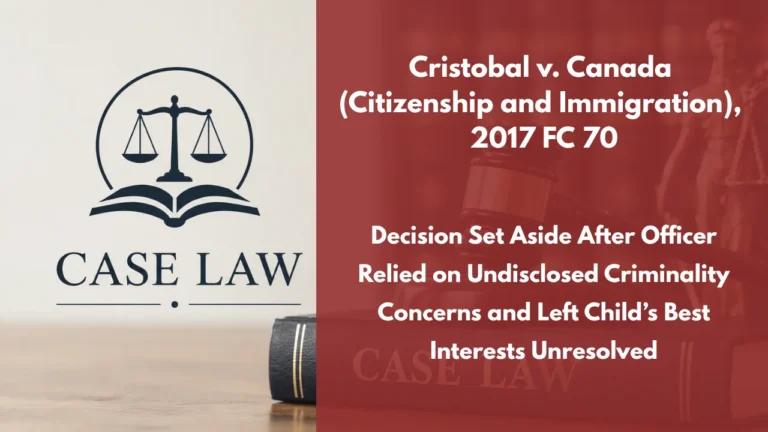


Mars VJ Tacadena Cristobal sought
judicial review after a visa officer refused humanitarian and compassionate
relief in his permanent residence application. Although he accepted that he was
excluded from the family class under paragraph 117(9)(d) of the IRPR, he
challenged the H&C refusal. The Federal Court found a serious procedural
fairness breach because the officer relied on undisclosed concerns arising from
a Philippine police certificate and speculated about possible criminal
inadmissibility without giving Cristobal an opportunity to respond.
Key Principle
Where an officer develops a
serious concern about possible criminality or inadmissibility from evidence
whose meaning is uncertain, procedural fairness requires the applicant to be
informed of that concern and given a meaningful opportunity to respond. An
officer cannot rely on speculation about criminal charges, particularly where
internal guidance recommends obtaining clarifying court, police or enhanced
clearance documents, without first putting the concern to the applicant. A
best-interests-of-the-child analysis should also reach an actual conclusion
rather than merely list relevant factors.
Background
Cristobal, a citizen of the
Philippines, married his sponsor in 2010. Their daughter was born in Canada
later that year. His wife had landed as a permanent resident without declaring
him as her spouse, making Cristobal excluded from the family class.
He therefore sought H&C
relief, relying principally on the best interests of his Canadian-citizen
daughter and the benefits of family reunification.
Cristobal submitted an NBI
certificate stating “No Criminal Record.” CBSA material, however, warned that
such wording could have several meanings and recommended obtaining court
records, police reports and an enhanced NBI clearance where clarification was
required. The officer instead treated the certificate as indicating that
Cristobal had been charged with an offence.
Court Findings
• Undisclosed Criminality
Concern Breached Procedural Fairness
The officer speculated that
Cristobal might be criminally inadmissible and that his wife might also face
admissibility concerns because she had not declared a spouse whose criminal
history could have affected her immigration application. These were serious
concerns, yet they were never identified in the procedural fairness letter.
• Officer Failed to Follow the
Available Clarification Process
The Court emphasized that the
officer lacked a concrete basis for concluding that Cristobal had been
criminally charged. Despite CBSA guidance specifically recommending further
documents to interpret the NBI result, the officer did not request them. Cristobal
was therefore denied an opportunity to clarify the record before the officer
relied on criminality in assessing H&C relief.
• Best Interests Analysis Was
Left Incomplete
The Court also expressed
reservations about the BIOC assessment. Although the officer listed several
factors concerning Cristobal’s daughter and the family relationship, the
analysis moved into the criminality concern without reaching a clear conclusion
on the child’s best interests. The Court stated that BIOC should not be left
unresolved if the analysis is to comply with Kanthasamy.
Outcome
The Federal Court granted
judicial review, set aside the refusal and remitted the matter to a different
visa officer for redetermination. No question was certified and no costs were
ordered.
Case
Citation:
Cristobal v. Canada (Citizenship and Immigration), 2017 FC 70 (CanLII)
Written by:
Dr. Muhammad
Abrar (Barrister and
Solicitor)
Author | Writer | Mentor | Legal Researcher | Canadian Immigration Case Law and
Statistics Analyst

Barrister & Solicitor
From temporary status to PR, get expert legal help to choose the right immigration pathway.








© 2026 A&M Canadian Immigration Law Corporation | All Rights Reserved.