



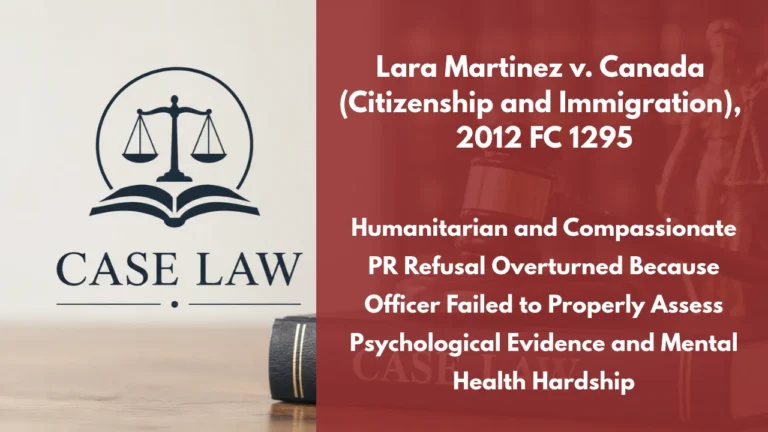

The Federal Court reviewed the refusal of a humanitarian and
compassionate (H&C) permanent residence application involving a Mexican
woman who feared discrimination and psychological hardship because of her
sexual orientation and mental health conditions.
The Court overturned the refusal because the immigration
officer failed to meaningfully consider expert psychological evidence
explaining how returning to Mexico could seriously worsen the applicant’s
mental health.
Key Principle
Under section 25 of the Immigration and Refugee Protection
Act (IRPA), immigration officers must meaningfully assess the individual
circumstances and supporting evidence presented in H&C applications.
When an applicant submits expert psychological evidence
showing that removal may significantly worsen their mental health, an officer
cannot dismiss that concern merely because mental health treatment may be
available in the country of return.
The assessment must address the potential psychological
consequences of removal itself.
Background
Nora Adriana Lara Martinez, a Mexican citizen, entered
Canada as a visitor in July 2008.
She identified as a lesbian and described years of
discrimination, sexual harassment, threats and mistreatment in Mexico because
of her gender and sexual orientation.
She also experienced serious psychological difficulties,
including a previous suicide attempt.
Her refugee claim was refused in September 2010.
In December 2010, she submitted an H&C application
supported by a psychological assessment diagnosing post-traumatic stress
disorder (PTSD) and major depressive disorder.
The psychologist concluded that returning to Mexico would
likely significantly worsen her symptoms and compromise her mental health.
The immigration officer refused her H&C application in
December 2011.
Court Findings
First, the officer failed to properly assess the
psychological report.
Although the officer accepted the diagnoses of PTSD and
major depressive disorder, the decision did not meaningfully address the
psychologist’s conclusion that removal would significantly worsen the
applicant’s condition.
Second, the availability of treatment was not sufficient.
The Court emphasized that access to mental health services
did not answer whether returning the applicant to an environment associated
with her trauma would cause serious psychological hardship.
Third, the psychological evidence was central to the
application.
The applicant had expressly relied on emotional and mental
hardship. The officer could not reasonably treat these concerns as secondary
without explanation.
Fourth, the officer inadequately explained the assessment of
past discrimination.
The Court questioned the conclusion that the applicant’s
experiences were unrelated to her gender or sexual orientation. However, this
potential error was not independently determinative because the H&C
hardship assessment was forward-looking.
Fifth, the officer had not otherwise applied the wrong
hardship test.
The Court accepted that state protection and changing
country conditions could be relevant considerations. The decisive error
remained the failure to adequately assess psychological hardship.
Outcome
The Federal Court allowed judicial review because the
officer’s treatment of the applicant’s mental health evidence rendered the
H&C decision unreasonable.
The decision confirms that immigration officers must assess
the potential psychological consequences of removal, particularly where
uncontradicted expert evidence identifies a serious risk of deteriorating
mental health.
The Court did not directly grant PR status or determine that
every aspect of the officer’s hardship assessment was unreasonable.
Case Citation:
Lara Martinez v. Canada (Citizenship and Immigration), 2012 FC 1295 CanLII
Prepared by:
Dr. Muhammad Abrar (Barrister and Solicitor)
Author | Writer | Mentor | Legal Researcher | Canadian Immigration Case Law and Statistics Analyst

Barrister & Solicitor
From temporary status to PR, get expert legal help to choose the right immigration pathway.








© 2026 A&M Canadian Immigration Law Corporation | All Rights Reserved.