Logo of A&M Canadian Immigration law Corporation

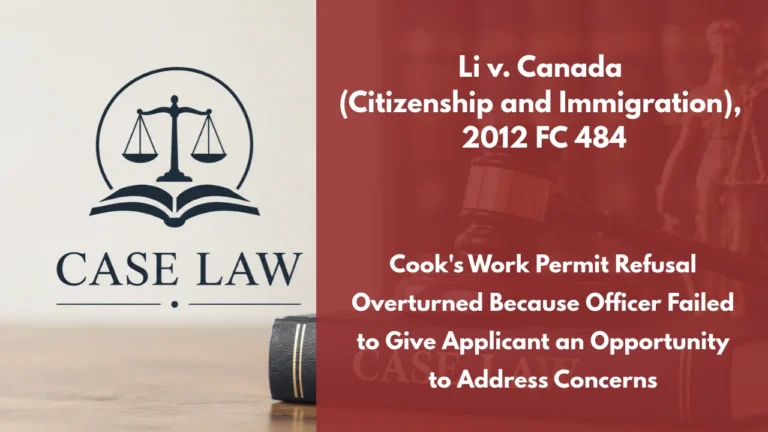
Li v. Canada (Citizenship and Immigration), 2012 FC 484 : Cook’s Work Permit Refusal Overturned Because Officer Failed to Give Applicant an Opportunity to Address Concerns

The Federal Court reviewed the refusal of a Canadian work permit application submitted by an experienced cook who had received a positive Labour Market Opinion (LMO).

The Court overturned the refusal because the immigration officer failed to provide the applicant an opportunity to address concerns about his English proficiency and relevant work experience, despite substantial supporting evidence already submitted.

Key Principle

Under paragraph 200(3)(a) of the Immigration and Refugee Protection Regulations (IRPR), an officer must not issue a work permit where reasonable grounds exist to believe the applicant cannot perform the proposed employment.

Although work permit applicants generally bear the responsibility of establishing their qualifications, procedural fairness may require an opportunity to respond when an officer’s concerns are not adequately supported by the application requirements or the evidence.

This obligation depends on the particular circumstances and does not create an automatic right to an interview or additional document requests.

Background

Newn Shin Li, an Indian citizen of Chinese ancestry, applied for a Canadian work permit in December 2010.

He had received an employment offer from Royal Chinese Seafood Restaurant in Scarborough, Ontario, to work as a cook specializing in Indian-style Hakka Chinese cuisine.

The application included a positive LMO confirming the employment offer.

To demonstrate his qualifications, Mr. Li submitted school certificates showing passing grades in English, employment reference letters and salary slips documenting more than seven years of experience as a head chef.

However, the visa officer refused his application in January 2011, concluding that he had not sufficiently demonstrated English proficiency or specific experience preparing Hakka Chinese food.

Court Findings

The Federal Court identified exceptional circumstances requiring additional procedural fairness.

First, the officer inadequately addressed the submitted English-language evidence.

Mr. Li had provided school records showing passing grades in English. The LMO required written and spoken English but specified no particular proficiency level.

Second, the officer failed to meaningfully assess the applicant’s professional experience.

His employment references described extensive cooking experience, particularly in Asian cuisine, with responsibilities substantially overlapping those of the proposed Canadian position.

Third, procedural fairness required an opportunity to respond.

Although officers generally need not seek clarification about incomplete work permit applications, the existing evidence and limited regulatory guidance justified an exception in this case.

The Court found that the officer should have allowed Mr. Li to address the concerns before refusing his application.

Outcome

The Federal Court allowed judicial review, set aside the work permit refusal and referred the application to a different immigration officer for reconsideration.

The decision demonstrates that officers cannot disregard relevant evidence and, in exceptional circumstances, must give applicants an opportunity to clarify concerns about their qualifications.

The Court did not determine that Mr. Li qualified for a work permit, nor did it decide his separate challenge to the reasonableness of the refusal.

No question of general importance was certified.


Case Citation:

Li v. Canada (Citizenship and Immigration), 2012 FC 484 CanLII
Visit our Social Media:

CATEGORIES

Case Law Library (1428)Case Law Update - January 2026 (13)Case Law Update - February 2026 (9)Case Law Update - March 2026 (13)Case Law Update - April 2026 (9)Case Law Update - May 2012 (6)Case Law Update - May 2013 (5)Case Law Update - May 2014 (6)Case Law Update - May 2015 (9)Case Law Update - May 2016 (7)Case Law Update - May 2017 (4)Case Law Update - May 2018 (4)Case Law Update - May 2019 (3)Case Law Update - May 2020 (4)Case Law Update - May 2021 (6)Case Law Update - May 2022 (10)Case Law Update - May 2023 (10)Case Law Update - May 2024 (13)Case Law Update - May 2026 (10)Case Law Update – May 2025 (18)Case Law Update - June 2026 (24)Case Law Update - October 2026 (11)Case Law Update - Apr. 2012 (12)Case Law Update - Apr. 2013 (4)Case Law Update - Apr. 2014 (3)Case Law Update - Apr. 2015 (9)Case Law Update - Apr. 2016 (8)Case Law Update - Apr. 2017 (6)Case Law Update - Apr. 2018 (7)Case Law Update - Apr. 2019 (6)Case Law Update - Apr. 2020 (8)Case Law Update - Apr. 2022 (11)Case Law Update - Apr. 2023 (11)Case Law Update - Apr. 2024 (14)Case Law Update - Aug. 2012 (6)Case Law Update - Aug. 2013 (5)Case Law Update - Aug. 2014 (7)Case Law Update - Aug. 2015 (10)Case Law Update - Aug. 2016 (3)Case Law Update - Aug. 2017 (4)Case Law Update - Aug. 2018 (5)Case Law Update - Aug. 2019 (4)Case Law Update - Aug. 2020 (5)Case Law Update - Aug. 2021 (8)Case Law Update - Aug. 2022 (7)Case Law Update - Aug. 2023 (10)Case Law Update - Aug. 2024 (7)Case Law Update - Aug. 2026 (8)Case Law Update - Dec. 2012 (7)Case Law Update - Dec. 2013 (4)Case Law Update - Dec. 2014 (3)Case Law Update - Dec. 2015 (3)Case Law Update - Dec. 2016 (3)Case Law Update - Dec. 2017 (5)Case Law Update - Dec. 2018 (7)Case Law Update - Dec. 2019 (5)Case Law Update - Dec. 2020 (5)Case Law Update - Dec. 2021 (9)Case Law Update - Dec. 2023 (6)Case Law Update - Dec. 2024 (15)Case Law Update - Dec. 2025 (11)Case Law Update - Feb. 2012 (11)Case Law Update - Feb. 2013 (7)Case Law Update - Feb. 2014 (4)Case Law Update - Feb. 2015 (5)Case Law Update - Feb. 2016 (7)Case Law Update - Feb. 2017 (8)Case Law Update - Feb. 2018 (8)Case Law Update - Feb. 2019 (6)Case Law Update - Feb. 2020 (7)Case Law Update - Feb. 2021 (3)Case Law Update - Feb. 2022 (11)Case Law Update - Feb. 2023 (14)Case Law Update - Feb. 2024 (16)Case Law Update - Jan. 2012 (5)Case Law Update - Jan. 2013 (6)Case Law Update - Jan. 2014 (7)Case Law Update - Jan. 2015 (9)Case Law Update - Jan. 2016 (7)Case Law Update - Jan. 2017 (8)Case Law Update - Jan. 2018 (8)Case Law Update - Jan. 2019 (6)Case Law Update - Jan. 2020 (11)Case Law Update - Jan. 2021 (3)Case Law Update - Jan. 2022 (7)Case Law Update - Jan. 2023 (9)Case Law Update - Jan. 2024 (13)Case Law Update - Jul. 2012 (7)Case Law Update - Jul. 2013 (11)Case Law Update - Jul. 2014 (7)Case Law Update - Jul. 2015 (5)Case Law Update - Jul. 2016 (13)Case Law Update - Jul. 2017 (5)Case Law Update - Jul. 2018 (8)Case Law Update - Jul. 2019 (7)Case Law Update - Jul. 2020 (4)Case Law Update - Jul. 2021 (9)Case Law Update - Jul. 2022 (7)Case Law Update - Jul. 2023 (11)Case Law Update - Jul. 2024 (16)Case Law Update - Jul. 2025 (16)Case Law Update - Jul. 2026 (13)Case Law Update - Jun. 2012 (8)Case Law Update - Jun. 2013 (6)Case Law Update - Jun. 2014 (4)Case Law Update - Jun. 2015 (9)Case Law Update - Jun. 2016 (4)Case Law Update - Jun. 2017 (5)Case Law Update - Jun. 2018 (6)Case Law Update - Jun. 2019 (6)Case Law Update - Jun. 2020 (4)Case Law Update - Jun. 2021 (14)Case Law Update - Jun. 2022 (9)Case Law Update - Jun. 2023 (10)Case Law Update - Jun. 2024 (16)Case Law Update - Jun. 2025 (9)Case Law Update - Mar. 2012 (7)Case Law Update - Mar. 2013 (7)Case Law Update - Mar. 2014 (6)Case Law Update - Mar. 2015 (8)Case Law Update - Mar. 2016 (7)Case Law Update - Mar. 2017 (4)Case Law Update - Mar. 2018 (8)Case Law Update - Mar. 2019 (8)Case Law Update - Mar. 2020 (9)Case Law Update - Mar. 2021 (2)Case Law Update - Mar. 2022 (10)Case Law Update - Mar. 2023 (11)Case Law Update - Mar. 2024 (15)Case Law Update - Nov. 2012 (6)Case Law Update - Nov. 2013 (6)Case Law Update - Nov. 2014 (5)Case Law Update - Nov. 2015 (5)Case Law Update - Nov. 2016 (6)Case Law Update - Nov. 2017 (5)Case Law Update - Nov. 2018 (5)Case Law Update - Nov. 2019 (5)Case Law Update - Nov. 2020 (2)Case Law Update - Nov. 2021 (11)Case Law Update - Nov. 2023 (12)Case Law Update - Nov. 2024 (14)Case Law Update - Nov. 2025 (11)Case Law Update - Oct. 2012 (5)Case Law Update - Oct. 2013 (4)Case Law Update - Oct. 2014 (4)Case Law Update - Oct. 2015 (6)Case Law Update - Oct. 2016 (7)Case Law Update - Oct. 2017 (5)Case Law Update - Oct. 2018 (8)Case Law Update - Oct. 2019 (8)Case Law Update - Oct. 2020 (1)Case Law Update - Oct. 2021 (10)Case Law Update - Oct. 2023 (10)Case Law Update - Oct. 2024 (16)Case Law Update - Oct. 2025 (13)Case Law Update - Sep. 2012 (7)Case Law Update - Sep. 2013 (4)Case Law Update - Sep. 2014 (8)Case Law Update - Sep. 2015 (7)Case Law Update - Sep. 2016 (10)Case Law Update - Sep. 2017 (4)Case Law Update - Sep. 2018 (5)Case Law Update - Sep. 2019 (7)Case Law Update - Sep. 2020 (3)Case Law Update - Sep. 2021 (10)Case Law Update - Sep. 2022 (10)Case Law Update - Sep. 2023 (6)Case Law Update - Sep. 2024 (15)Case Law Update - Sep. 2025 (17)Case Law Update - Sep. 2026 (13)Case Law Update – Apr. 2021 (4)Case Law Update – Apr. 2025 (9)Case Law Update – Aug. 2025 (8)Case Law Update – Dec. 2022 (10)Case Law Update – Feb. 2025 (8)Case Law Update – Jan. 2025 (17)Case Law Update – Mar. 2025 (17)Case Law Update – Nov. 2022 (11)Case Law Update – Oct. 2022 (6)

About The Author

Picture of Dr. Muhammad Abrar

Dr. Muhammad Abrar

Barrister & Solicitor

From temporary status to PR, get expert legal help to choose the right immigration pathway.

Contact our office for details. Our immigration legal service in Winnipeg will assess your eligibility per CIC criteria and submit your application.