


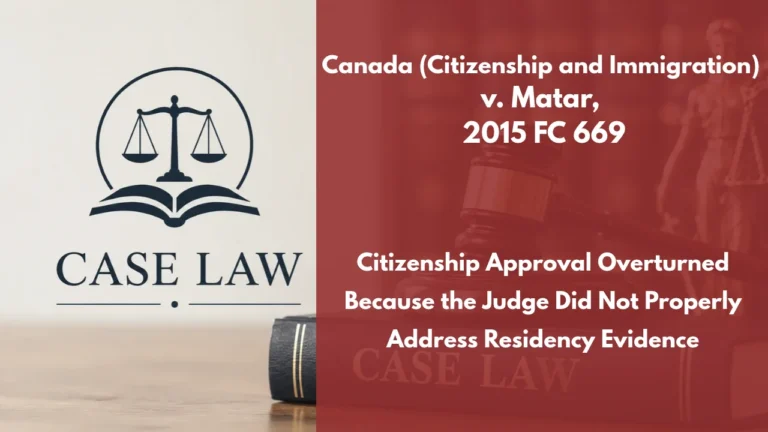

The Federal Court reviewed a decision where a Citizenship
Judge had approved an applicant for Canadian citizenship after finding that he
met the required physical presence test.
The Minister challenged that approval because the
applicant’s travel records appeared to show significantly more absences from
Canada than he had declared.
The Federal Court found that the Citizenship Judge failed to
properly address important contradictions in the evidence and did not
adequately explain how the residency requirement had been met.
The citizenship approval was therefore set aside and the
matter was returned for a new determination.
Key Principle
A decision-maker must address important evidence that
contradicts the conclusion being reached.
Where travel records, passport stamps, entry records, or
other documents raise serious questions about whether a citizenship applicant
met the residency requirement, those discrepancies must be meaningfully
considered and explained.
A reviewing court cannot fill in missing reasoning or
rewrite a decision to justify an outcome that the original decision-maker did
not properly explain.
Background
The applicant became a permanent resident of Canada in
October 2007 and applied for Canadian citizenship in July 2011.
In his citizenship application, he declared 106 days of
absence from Canada during the relevant period.
A citizenship officer later asked him to complete a
residence questionnaire because there were concerns about whether he met the
residency requirement.
The applicant provided similar information in the
questionnaire, although one trip to Lebanon was omitted.
A Citizenship Judge later held a hearing and obtained
additional entry information from the Integrated Customs Enforcement System, or
ICES.
The Citizenship Judge approved the application and found
that the applicant had met the applicable physical presence requirement.
The Judge also found the applicant credible and stated that
there were no material inconsistencies in his oral or documentary evidence.
Court Findings
The Federal Court found that the Citizenship Judge failed to
deal with important evidence that contradicted the applicant’s declared travel
history.
For example, the applicant stated that he had returned to
Canada from Lebanon on January 18, 2010 and remained in Canada until May 13,
2010.
However, his passport showed that he entered Qatar on
January 19, 2010 and left Qatar on May 13, 2010.
The Court explained that although the absence of a passport
stamp does not necessarily prove that travel did or did not occur, the presence
of an entry or exit stamp is evidence that must be considered.
There were also other periods where the applicant claimed to
have returned to Canada but there was no supporting passport stamp or ICES
entry confirming the return.
The Citizenship Judge did not explain how these
discrepancies were resolved.
The Court was also concerned about the Citizenship Judge’s
reliance on bank statements as evidence of physical presence in Canada.
Although the Judge referred to purchases in the Ottawa and
Gatineau area, the bank statements showed that during some of the disputed
periods the only activity was the accumulation of interest, rather than actual
purchases or transactions.
The Federal Court emphasized that it could review the record
to better understand a decision, but it could not create reasoning that the
Citizenship Judge had never provided.
Because the Judge did not explain how the conflicting
evidence had been considered, the Court could not determine how the conclusion
that the residency requirement was met had been reached.
Outcome
The Federal Court allowed the application for judicial
review and returned the citizenship application to another decision-maker
for redetermination.
The case demonstrates that citizenship applicants should
ensure that their travel history, passport records, entry records and
supporting documents are consistent.
It also shows that where significant contradictions exist, a
decision-maker must directly address them and explain why the evidence still
supports the conclusion reached.
Historical Note: This case was decided under the citizenship residency rules
and physical presence framework that applied at the time. Citizenship
legislation has since changed, so current physical presence requirements should
be assessed under the law presently in force.
Case Citation:
Canada (Citizenship and Immigration) v. Matar, 2015 FC 669 CanLII
Prepared by:
Dr. Muhammad Abrar (Barrister and Solicitor)
Author | Writer | Mentor | Legal Researcher | Canadian Immigration Case Law and Statistics Analyst

Barrister & Solicitor
From temporary status to PR, get expert legal help to choose the right immigration pathway.








© 2026 A&M Canadian Immigration Law Corporation | All Rights Reserved.