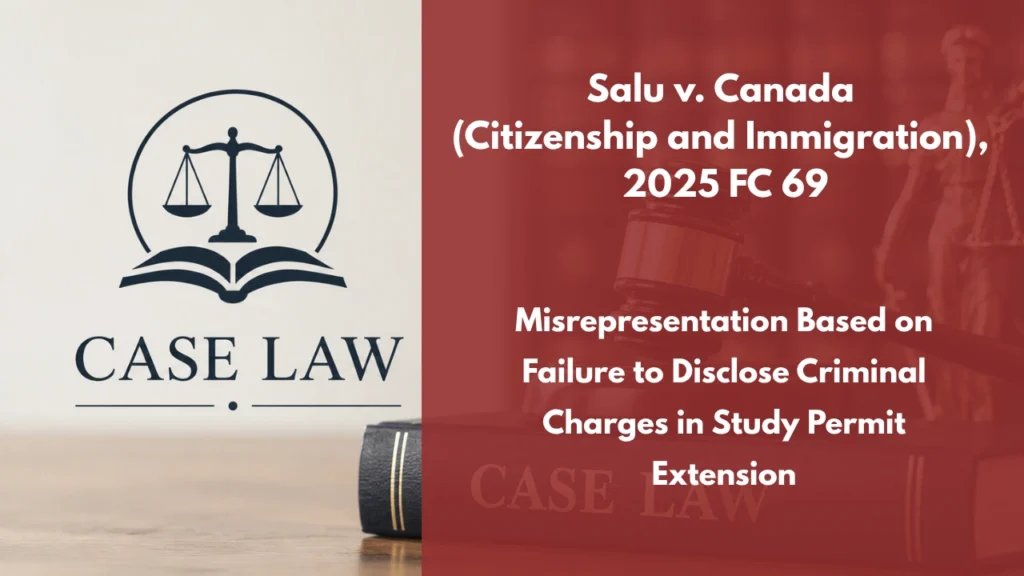
In Salu v. Canada (Citizenship
and Immigration), 2025 FC 69, the Federal Court reviewed an Immigration
Division decision finding the Applicant inadmissible to Canada for misrepresentation
under paragraph 40(1)(a) of IRPA. The Applicant had answered “No” when
asked whether she had ever been charged with a criminal offence, despite having
been charged with fraud over $5,000 and theft over $5,000 several months
earlier. The Court upheld the finding that the omission was material and that
the Applicant had not established an innocent mistake.
Key Principle
Under paragraph 40(1)(a) of IRPA,
a misrepresentation is material where it is sufficiently important to affect
the immigration process, even if it would not necessarily have changed the
ultimate outcome. A misrepresentation need not be intentional to result in
inadmissibility. The fact that immigration authorities might have discovered
the undisclosed information independently does not make the misrepresentation
immaterial.
The innocent mistake exception may apply where an applicant genuinely misunderstood a question or made an
honest error, but the asserted mistake must be assessed against the evidence
and must be objectively reasonable in the circumstances.
Background
The Applicant, Omodolamu Fatimoh
Salu, was charged in December 2021 with fraud over $5,000 and theft over $5,000
arising from transactions at her workplace. The charges subsequently proceeded
through diversion and ultimately resulted in a joint submission for a
conditional discharge after restitution, expressly taking into account the
potential immigration consequences of a conviction.
In June 2022, while applying to
extend her study permit, Ms. Salu answered “No” to the question asking
whether she had ever committed, been arrested for, been charged with, or been
convicted of a criminal offence. The Immigration Division later found that this
answer constituted a material misrepresentation.
The Applicant argued that she
honestly believed she had not been charged and relied on the innocent mistake
exception. She also relied on evidence concerning her ADHD and difficulties
understanding the criminal proceedings.
Court Findings
• The misrepresentation was
material: The Court upheld the ID’s finding that the undisclosed charges
could have affected the processing and assessment of the study permit
extension. It was irrelevant that the charges might have been discovered
through Canadian law-enforcement channels or that the application might
ultimately have received the same result. The statutory test asks whether the
misrepresentation “could induce an error” in the administration of IRPA.
• Intent was not required: The Court confirmed that paragraph 40(1)(a) does not require proof that the
Applicant deliberately intended to mislead immigration authorities. A
non-intentional misrepresentation may still result in inadmissibility.
• Innocent mistake was not
objectively reasonable: Although the ID considered evidence that the
Applicant was nervous and had difficulty understanding the proceedings, it also
considered that she had appeared in court, understood that the matter concerned
theft, and had been told by the arresting officer multiple times that she faced
criminal charges. The ID was therefore entitled to conclude that she was aware,
or should reasonably have understood, that she had been charged.
• ADHD evidence did not
establish the exception: The ID considered the Applicant’s ADHD diagnosis
and medication but found insufficient medical evidence demonstrating that the
condition prevented her from understanding the criminal charges. The Federal
Court found this reasoning reasonable and declined to reweigh the evidence.
Outcome
The Federal Court found that the
ID’s decision was transparent, intelligible, justified and reasonable.
The judicial review application was therefore dismissed, and no question
was certified.
Case
Citation:
Salu v. Canada (Citizenship and Immigration), 2025 FC 69 (CanLII)
Prepared by:
Dr. Muhammad
Abrar (Barrister and
Solicitor)
Author | Writer | Mentor | Legal Researcher | Canadian
Immigration Case Law and Statistics Analyst