The Federal Court reviewed the
refusal of Nurtai Munzhurov’s TRP application, which accompanied unsuccessful
applications for a PGWP and restoration of status. Although the applicant
conceded that he was not eligible for a PGWP because he had not maintained
full-time student status, the Court found the separate TRP refusal unreasonable
because the officer provided no meaningful explanation for concluding that a
TRP was not justified.
Key Principle
A TRP officer must meaningfully
assess whether an applicant’s circumstances justify relief from the strict
application of immigration requirements. Boilerplate language stating only that
a TRP is “not justified” is insufficient where the applicant has provided
specific submissions explaining the compelling circumstances, immigration
history, reasons for remaining in Canada, and benefits associated with granting
temporary status.
Background
The applicant came to Canada in
2015 to complete a four-year bachelor’s degree. Although he generally studied
full-time, his transcript showed that he had been part-time for more than his
final academic session, making him ineligible for a PGWP. After his first PGWP
refusal, he applied for a new PGWP, restoration of status, and a TRP intended
to overcome his PGWP ineligibility.
Court Findings
• Restoration Decision
Contained an Error but Was Not Determinative
The officer incorrectly concluded
that the applicant had missed the deadline to restore his status. A COVID-19
public policy had extended the restoration period until August 31, 2021,
meaning his March 2021 application was timely. However, this error did not
affect PGWP eligibility because the applicant still failed the full-time study
requirement.
• TRP Required a Separate
Discretionary Assessment
The Court emphasized that a TRP
exists to soften the potentially harsh consequences of strict immigration
requirements where compelling circumstances justify temporary status. The
officer therefore had to separately assess whether the applicant’s circumstances
warranted relief despite his non-compliance.
• Applicant Provided Specific
Circumstances for Consideration
The applicant explained that he
met the other PGWP requirements and provided reasons for his failure to
maintain full-time status. Relevant TRP considerations included his immigration
history, reasons for remaining in Canada, potential benefits to himself and
others, and whether his circumstances outweighed any risk associated with
granting temporary status.
• Officer Did Not Demonstrate
That Relevant Factors Were Assessed
The officer merely stated that
the application had been considered and that a TRP was not justified. The
reasons did not show whether the applicant’s submissions, compelling need,
immigration history, benefits, or any potential risks were actually assessed.
• Boilerplate Language
Prevented Meaningful Judicial Review
The Court could not determine
whether the officer applied the proper TRP framework or simply used
standardized wording. While reasons may be brief, they must still reveal a
rational chain of analysis and permit the Court to understand how the evidence
led to the result.
• Court Could Not Supply
Missing Reasons
The Court stressed that it could
not speculate about the officer’s reasoning or reconstruct an analysis that did
not appear in the decision or record. Because the reasons lacked justification,
transparency, and intelligibility, the TRP refusal could not stand.
Outcome
The Federal Court granted
judicial review of the TRP refusal, set aside the decision, and remitted the
matter to a different decision-maker for reconsideration. No question of
general importance was certified.
Case
Citation:
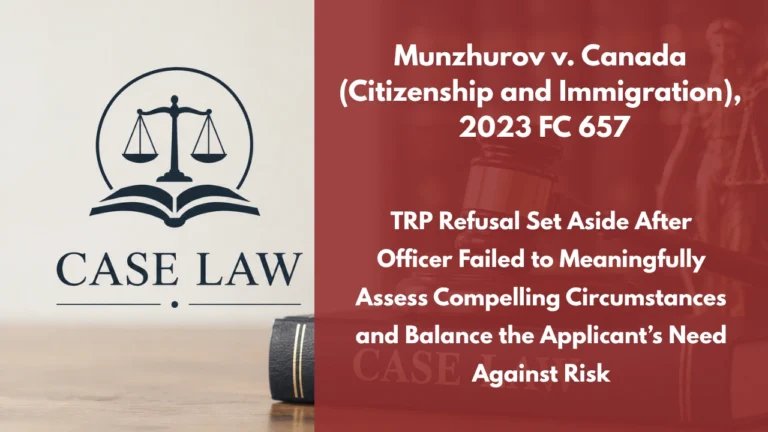
Munzhurov v. Canada (Citizenship and Immigration), 2023 FC 657 (CanLII)
Prepared by:
Dr. Muhammad
Abrar (Barrister and
Solicitor)
Author | Writer | Mentor | Legal Researcher | Canadian Immigration Case Law and
Statistics Analyst