
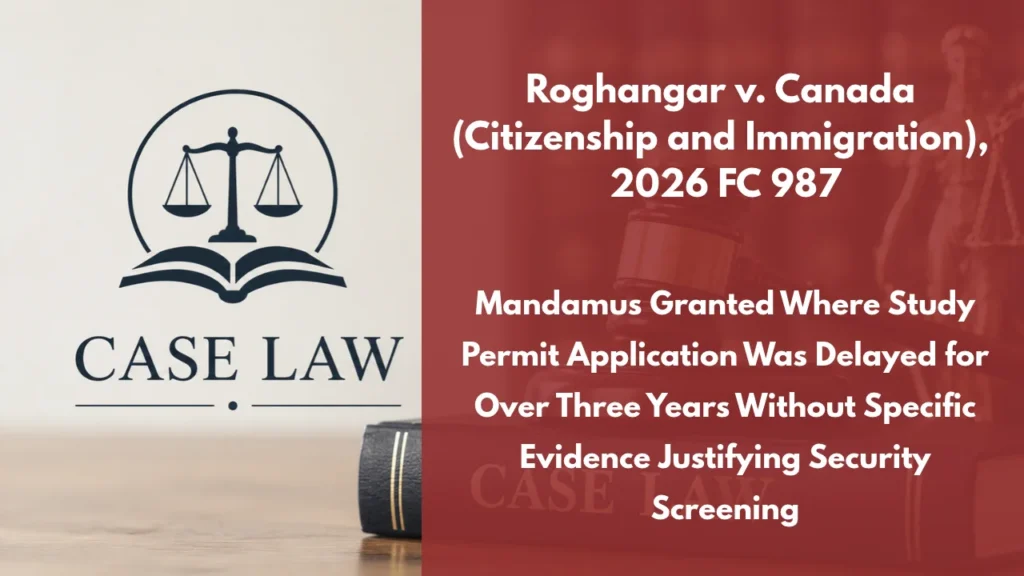


The Federal Court granted
judicial review and issued a writ of mandamus requiring IRCC to decide the
Applicant’s study permit application within 45 days. The Court found that the
application had been pending for approximately 3.5 years—about 20 times IRCC’s
60-day service standard—and that IRCC failed to provide evidence specifically
explaining or justifying the prolonged security screening. Pasted text
Key Principle
A general assertion that an
application is undergoing security screening is not sufficient to justify an
unreasonable delay. Once an applicant establishes that the delay is prima
facie excessive and that the applicant is not responsible for it, the
Respondent must provide evidence specifically connected to the particular
applicant explaining why the delay is justified. Pasted text
Security screening is an
important and mandatory part of immigration processing, but the government
cannot rely on generalized statements about security screening, processing
complexity, or workload and ask the Court to speculate about why a particular application
remains outstanding. Pasted text
Background
The Applicant, an Iranian
citizen, applied for a study permit in January 2023 after being accepted into a
Master’s program in Mechanical Engineering at the University of Saskatchewan.
IRCC requested his military records, which disclosed approximately one year of
mandatory service as a Sergeant Major with the police in Iran. His application
was referred for a security assessment shortly afterward. Pasted text
The Applicant repeatedly
contacted IRCC and sought assistance from constituency offices. IRCC issued
“patience letters” stating that the application remained under review. In April
2025, IRCC advised that further background checks and verifications were required
and that processing would exceed posted times. Pasted text
Court Findings
• Delay was prima facie
unreasonable: The application had remained pending for 1,262 days. The
Court relied on IRCC’s 60-day service standard for out-of-country study permits
and noted that the delay was approximately 20 times longer than that
standard. The Applicant had also lost a specific university research
opportunity because of the delay. Pasted text
• Security screening did not
automatically justify the delay: The Court accepted that security
assessments may legitimately cause delays, but held that this issue belongs
principally under the justification stage of the Conille analysis. The
Respondent therefore had to provide evidence showing why this particular
application required such prolonged processing. Pasted text
• Insufficient evidence from
IRCC: The Respondent relied primarily on three old GCMS entries referring
to a “pending partner” and a referral to a mission. There was no evidence
explaining what those entries meant, what further security steps remained, or
how long completion would take. Pasted text
• Blanket security statements
insufficient: The Court rejected IRCC’s reliance on general assertions that
military or police service, country of origin, application complexity, or
security-screening volumes can cause delays. Such generalized factors cannot
substitute for evidence concerning the particular application. Pasted text
• Distinguished cases with
detailed security evidence: Unlike Naeemi, where detailed evidence
established ongoing security concerns and recent processing activity, the
record here contained no comparable evidence. Pasted text
Outcome
The Court granted judicial review
and issued a writ of mandamus, requiring IRCC to render a decision on
the study permit application within 45 days. The Court also awarded the
Applicant $1,000 in costs, finding that IRCC’s reliance on blanket
security-screening statements had resulted in unnecessary litigation.
Case
Citation:
Roghangar v. Canada (Citizenship and Immigration), 2026 FC 987 (CanLII)
Prepared by:
Dr. Muhammad
Abrar (Barrister and
Solicitor)
Author | Writer | Mentor | Legal Researcher | Canadian Immigration Case Law and
Statistics Analyst

Barrister & Solicitor
From temporary status to PR, get expert legal help to choose the right immigration pathway.








© 2026 A&M Canadian Immigration Law Corporation | All Rights Reserved.