The
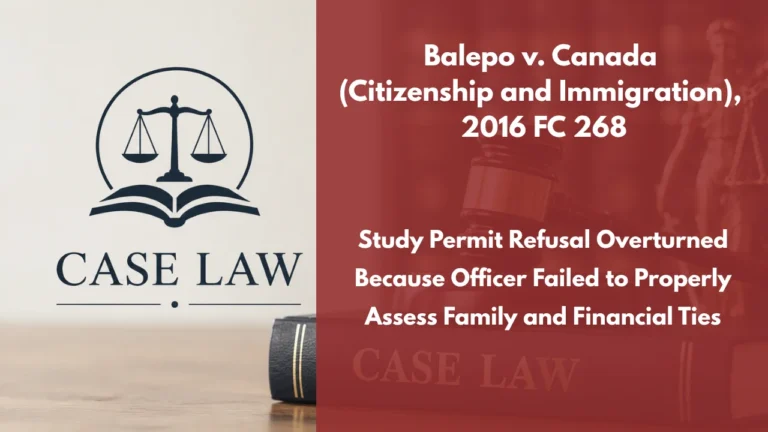
Federal Court reviewed a Temporary Resident Visa (TRV) refusal involving a
citizen of the Philippines who wished to visit family members in Canada. The
Court allowed the judicial review after finding that the visa officer made a
critical factual error regarding the applicant’s family ties, leading to an
unreasonable assessment of whether she would leave Canada at the end of her
authorized stay.
The
case confirms that visa officers must accurately assess evidence relating to
an applicant’s family ties when determining whether they will leave Canada at
the end of their authorized stay. A material factual error concerning family
relationships may render a TRV refusal unreasonable and justify judicial
intervention.
Background
Maria
Doren Aljecera applied for a TRV to visit her family in Canada, including her
mother, whom she had not seen since 1989, and a brother whom she had never met.
The visa officer refused the application under section 179(b) of the
Immigration and Refugee Protection Regulations (IRPR), concluding that the
applicant had significant family ties in Canada, lacked significant family ties
outside Canada, was not sufficiently established in her home country, and had
limited employment prospects.
The
officer’s GCMS notes further stated that the applicant had “only one declared
family member in Canada (son) residing at a different address.” This finding
became central to the refusal because it suggested that the applicant had
minimal family ties in the Philippines and stronger incentives to remain in
Canada permanently.
Court
Findings
The
Attorney General of Canada later conceded that the decision contained a
material factual error. The record clearly showed that the applicant’s son
lived in the Philippines, not Canada. The family information form submitted
with the application identified the son as residing in the Philippines, making
the officer’s finding directly contrary to the evidence.
Justice
Ferron agreed that the officer had misapprehended a key fact concerning the
applicant’s family ties. The Court held that the erroneous finding
significantly affected the analysis of the applicant’s ties to her home country
and her likelihood of leaving Canada at the end of her visit. Because family
ties are often a central consideration in TRV assessments, the mistake
undermined the reasonableness of the entire decision.
The
Court noted that the error was not merely typographical. Rather, it reflected a
misunderstanding of the evidence that formed part of the officer’s reasoning
process. Since the refusal relied on an inaccurate assessment of the
applicant’s family situation, the decision could not stand.
Outcome
The Federal Court allowed the judicial review, set aside the TRV refusal, and returned the matter to a different officer for reconsideration. The applicant was also permitted to submit updated supporting documentation before the new assessment.
Prepared by:
Dr. Muhammad Abrar (Barrister and Solicitor)
Author | Writer | Mentor | Legal Researcher | Canadian Immigration Case Law and Statistics Analyst