A lot of Americans assume that if an old offence did not stop them from working, traveling within the United States, or moving on with life, it should not suddenly become a problem at the Canadian border.
That is often not how it works.
Canada applies its own immigration law when deciding who can enter the country. A past
conviction in the United States can lead to criminal inadmissibility, even where the offence seems minor from an American point of view. In some cases, the issue only comes up after travel plans are already booked and the person is standing in front of a border officer.
For Americans planning to visit Canada for business, family, tourism, or events, it is important to understand how this legal framework works.
What criminal inadmissibility means
Criminal inadmissibility means that a person may be barred from entering Canada because
of past criminal conduct.
The governing law is section 36 of the Immigration and Refugee Protection Act (IRPA).
That section sets out when criminal history can make a person inadmissible to Canada.
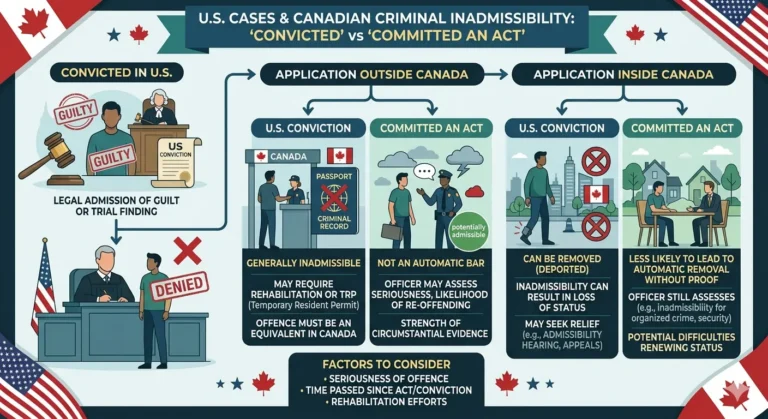
The analysis is not limited to offences committed inside Canada. It can also apply to
convictions or conduct that took place outside Canada, including in the United States.
Why a U.S. conviction can still affect entry to Canada
Many travelers assume the Canadian government will simply look at how the offence was
classified in the United States. That is not the full legal test.
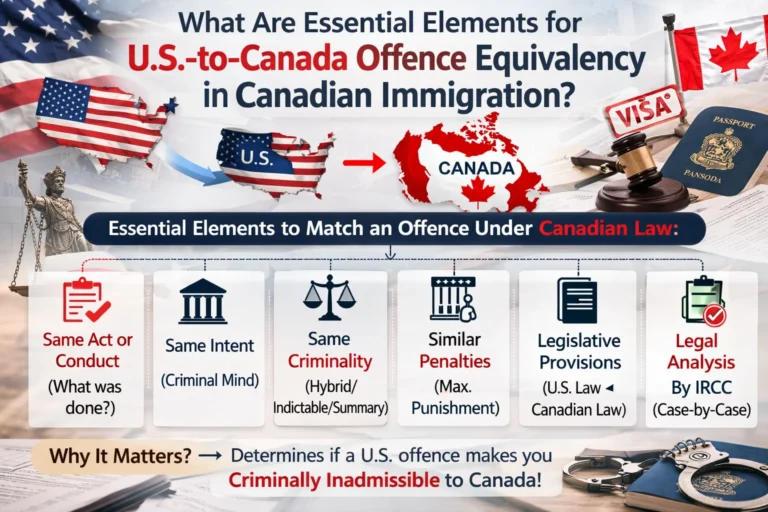
Canadian immigration authorities look at whether the offence has a Canadian equivalent. In other words, they ask what offence under Canadian law most closely matches the American charge or the underlying conduct.
That means a U.S. misdemeanor does not automatically stay “minor” for Canadian immigration
purposes. The Canadian equivalent may carry a different legal significance.
How section 36 of IRPA works
Section 36 separates criminal inadmissibility into different categories. This matters
because not every case is treated the same way.
In broad terms, the section distinguishes between:
● serious criminality
● ordinary criminality
That distinction can affect how the case is analyzed and what remedies may be available.
Serious criminality under section 36(1)
Section 36(1) deals with serious criminality.
This section applies to both:
● foreign nationals
● permanent residents
In general terms, serious criminality can arise where the relevant Canadian offence carries a maximum sentence of at least 10 years, or in certain Canadian conviction situations where a sentence of more than six months has been imposed.
For Americans trying to enter Canada, this often becomes important when the U.S. offence
corresponds to a Canadian offence that is treated more seriously than the traveler expected.
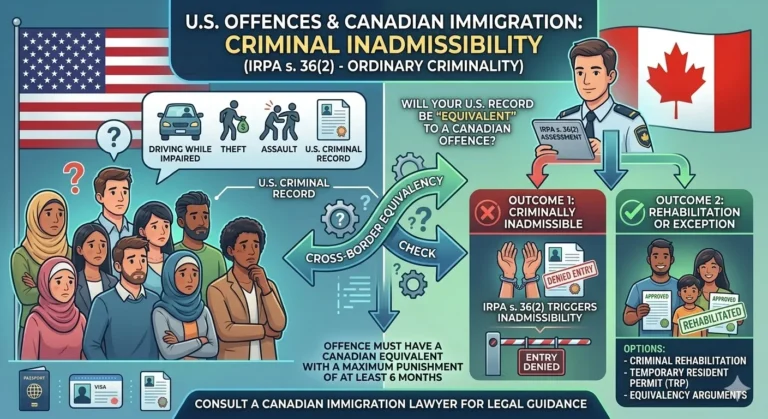
Criminality under section 36(2)
Section 36(2) deals with criminality.
This section applies to foreign nationals, which includes most Americans seeking to enter Canada as visitors, workers, or business travelers.
Criminality can arise even where the case does not meet the higher threshold for serious
criminality. That is one reason people are often surprised by border problems involving older offences that did not seem especially severe.
Serious criminality vs ordinary criminality: why the difference matters
This distinction is not just technical.
Whether a case falls under serious criminality or criminality can affect:
● how the case is assessed
● whether deemed rehabilitation may be possible
● whether criminal rehabilitation may be needed
● how urgently legal planning should happen before travel
For a law firm website, this distinction is worth explaining clearly because many readers
search for general answers without realizing the law uses these two separate concepts.
Common offences that can trigger inadmissibility
Several types of U.S. offences commonly lead to section 36 concerns for Americans entering
Canada.
These often include:
● DUI or DWI
● assault
● theft or shoplifting
● fraud
● drug possession or other drug-related offences
The exact result depends on the facts, the wording of the U.S. statute, the disposition, and the likely Canadian equivalent.
Why people are often caught off guard at the border
A lot of people believe that if the case is old, the border will not care.
Others assume that if they were allowed into Canada before, the issue is no longer relevant.
But criminal inadmissibility cases do not always show up the same way every time. A person
may cross in the past without difficulty and then later be questioned when the record is flagged or reviewed more closely.
That is one reason it is risky to assume everything is fine just because there has not been
a prior problem.
How Canadian equivalency affects the analysis
Canadian equivalency is one of the most important parts of the legal analysis.
The border officer or immigration decision-maker is not simply checking whether there was
a conviction. They are also asking what offence under Canadian law matches the
American one.
That can involve reviewing:
● the wording of the U.S. offence
● the facts of what happened
● the sentence imposed
● the maximum punishment under Canadian law
This is where many online summaries oversimplify the issue. The real legal answer often turns
on details.
Can conduct matter even without a conviction?
Yes, in some cases the legal analysis is not limited to convictions alone.
Section 36 can also refer to acts committed outside Canada. That is one reason criminal
inadmissibility questions can become more complicated than simply asking whether someone has a conviction on paper.
This does not mean every allegation leads to inadmissibility. It means the legal framework is
broader than many people expect.
What options may be available
Being inadmissible does not always mean travel to Canada is permanently impossible.
Depending on the case, possible options may include:
Temporary Resident Permit
A Temporary Resident Permit may allow a person to enter Canada temporarily despite
inadmissibility.
This is often relevant where travel is needed sooner rather than later.
Criminal Rehabilitation
Criminal rehabilitation is generally the more permanent solution.
Where available, it can resolve inadmissibility for the offences covered by the application.
Deemed Rehabilitation
In some cases, enough time may have passed for a person to argue that they are deemed
rehabilitated.
This is not available in every case, and the details matter.
Why timing matters more than people expect
People often calculate eligibility from the date of arrest or the date of conviction.
That is often the wrong starting point.
In many inadmissibility matters, what matters is when the sentence was fully completed.
That can include probation, fines, and other court-ordered conditions.
Because of that, a person may think enough time has passed when, legally, the relevant
clock started later.
Why supporting documents matter
These cases often depend on paperwork.
A proper review may require documents showing:
● the exact charge
● the final disposition
● the sentence imposed
● when every part of the sentence was completed
Without those records, it can be difficult to assess whether section 36 applies and what
solution may be available.
Why it is better to deal with the issue before travel
If a person already knows they have a conviction that could create a problem, it is usually
better to examine the issue before making the trip.
Waiting for the border to sort it out can lead to:
● cancelled plans
● missed family events
● disrupted business travel
● repeated refusals or delays
Advance legal review can help clarify the risk and identify whether a permit or rehabilitation process should be considered.
At A&M Canadian Immigration Law Corporation, we help Americans and U.S. residents
assess whether a past offence may make them inadmissible to Canada.
That can include reviewing the criminal history, identifying the likely Canadian equivalent, examining whether section 36 raises serious criminality or criminality concerns, and determining whether options like a Temporary Resident Permit or criminal rehabilitation may need to be considered.
Disclaimer
This article is for general educational purposes only and is not legal advice. Immigration law
can change, and every case depends on its own facts. If you may be inadmissible to Canada because of a past offence, obtain legal advice before making travel plans
or filing an application.
Sources
● Immigration and Refugee Protection Act, section 36
● Overcome criminal convictions
● Application for Rehabilitation for Persons Who Are Inadmissible to Canada Because of Past Criminal Activity
Written by:
Dr. Muhammad
Abrar (Barrister and Solicitor)
Author | Writer | Mentor | Legal Researcher | Canadian
Immigration Case Law and Statistics Analyst