Can Americans Enter Canada With a Criminal Record? A Complete Guide to Criminal
Inadmissibility
For a lot of Americans, a trip to Canada feels simple. It is close, familiar, and often just a short drive or flight away. So when someone gets stopped at the border because of an old criminal issue, it can come as a real shock.
Maybe it was a DUI from years ago. Maybe it was a theft conviction when you were younger.
Maybe you were charged with something, the case was resolved, and you never expected it to matter again.
But when it comes to entering Canada, past criminal issues can still matter.
That is because Canada uses Canadian immigration law to decide who can enter the
country. If Canada sees the offence as serious enough under its own laws, it can affect whether you are allowed in. The main legal framework is the Immigration and Refugee Protection Act,
especially section 36, which deals with criminal inadmissibility.
What criminal inadmissibility actually means
When someone is called criminally inadmissible, it means Canadian immigration law considers their criminal history serious enough to affect their right to enter or remain in Canada.
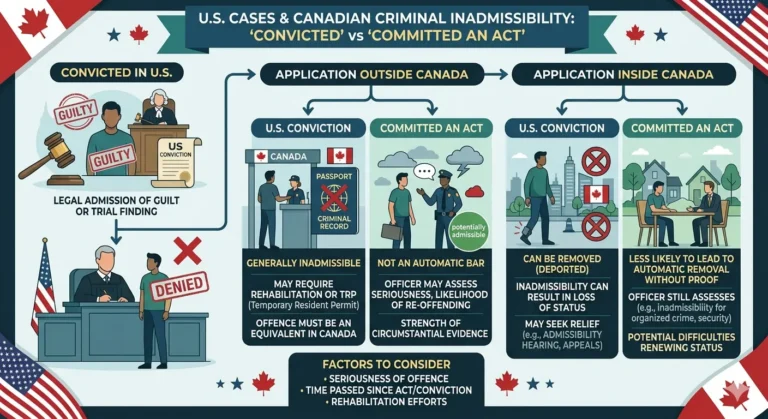
Under section 36 of the IRPA, a foreign national can be found inadmissible if they were convicted of a crime in Canada, convicted outside Canada of an offence that would also be a crime in Canada, or committed an act outside Canada that would be considered a criminal offence
both where it happened and under Canadian law. Canada’s public guidance also explains that criminal inadmissibility can arise from both minor and serious crimes, and that travelers may still have options to overcome it. See the Government of Canada pages on inadmissibility and overcoming criminal convictions.
Why a U.S. offence can still be a Canadian immigration problem
One of the biggest misunderstandings is thinking Canada will look at the offence the same way an American court did.
That is usually not how it works.
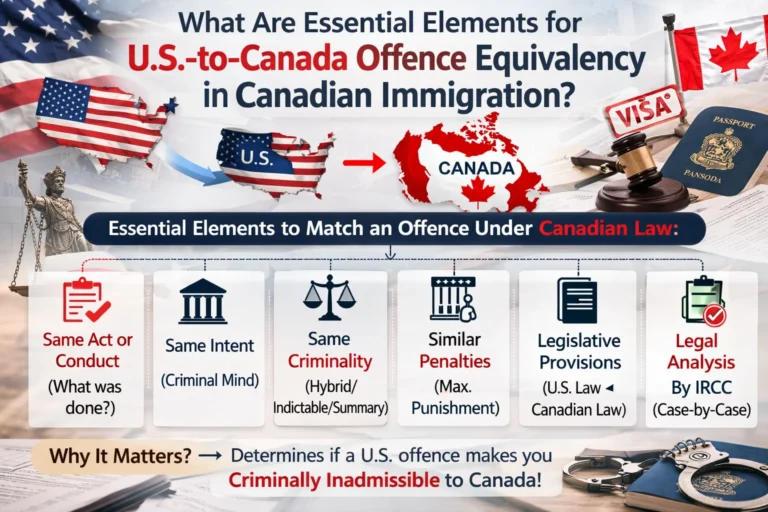
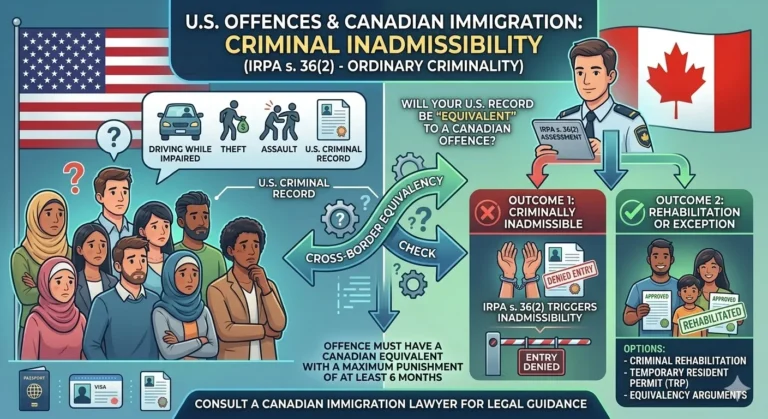
Canadian officers often compare the U.S. offence to its Canadian equivalent. So the real question is not just, “What was this called in the United States?” It is, “What would this be under Canadian law?” That is why an offence that may have seemed relatively minor in the U.S. can still cause trouble at the Canadian border. The Government of Canada specifically says that if you have
committed or been convicted of a crime, you may be inadmissible, and it lists examples such as theft, assault, manslaughter, dangerous driving, impaired driving, and drug offences.
The kinds of offences that often cause problems
Some offences come up again and again in inadmissibility cases involving Americans. Common
examples include:
● DUI or DWI
● assault
● theft or shoplifting
● fraud
● drug possession
● dangerous driving
● weapons offences
● multiple criminal convictions
Canada’s official guidance on overcoming criminal convictions specifically names several of these as examples of offences that can trigger criminal inadmissibility.
Why DUI is such a common issue
If there is one offence that catches American travelers off guard more than almost anything
else, it is probably a DUI.
A lot of people think of a DUI as a driving mistake that was dealt with years ago. But Canada
treats impaired driving very seriously. The Government of Canada says that if you were convicted of driving while impaired by alcohol or drugs, including cannabis, you may be inadmissible for serious criminality, whether the offence happened in Canada or outside Canada. See Convicted of driving while impaired.
What if charges were dropped?
This is where things get confusing for a lot of people.
If charges were dropped, that is not the same as a conviction, and it does not mean you committed the offence. But under Canadian immigration law, the lack of a conviction does not always end the discussion.
That is because section 33 of the IRPA says that, for inadmissibility findings under sections 34 to 37, the facts can include facts for which there are reasonable grounds to believe they have occurred, unless the Act says otherwise. In practical terms, that means immigration authorities may still look at whether there is enough credible information to conclude the underlying act happened.
So while a dropped charge is obviously better than a conviction, it does not always mean the incident will never come up again at the border.
What “reasonable grounds to believe” means
Immigration law uses a different standard than criminal court.
In criminal court, the standard is beyond a reasonable doubt. That is the high standard used to convict someone of a crime.
Immigration law works differently. Under section 33, certain inadmissibility findings can be made on reasonable grounds to believe. The Supreme Court of Canada has described that standard as more than mere suspicion, but less than proof on a balance of probabilities, based on credible and compelling information. See Mugesera v. Canada, 2005 SCC 40.
This difference helps explain why someone can sometimes face immigration problems even when
there was no conviction.
Can Americans still enter Canada if they are inadmissible?
Sometimes, yes.
Being criminally inadmissible does not always mean the answer is permanently no. Depending on the facts, there may still be legal options, including a Temporary Resident Permit, individual rehabilitation, or in some cases deemed rehabilitation. Canada’s official help centre says a person who is criminally inadmissible may still become admissible again if they qualify for deemed rehabilitation, are approved for rehabilitation, receive a pardon or record suspension where applicable, or are offered a temporary resident permit. See Can I enter Canada if I am criminally inadmissible?, Application for Rehabilitation, and Deemed rehabilitation.
Why it is worth checking before you travel
The worst time to find out there is a problem is when you are already standing at the border.
By then, the flights are booked, the hotel is paid for, your family is expecting you, or your work trip is already underway. And suddenly everything depends on how a border officer interprets something from your past.
That is why reviewing the issue beforehand can make a huge difference. Canada’s official
inadmissibility and rehabilitation guidance is clear that people with criminal histories may need to address the issue before travel, depending on the offence, the sentence, and how much time has passed.
At A&M Canadian Immigration Law Corporation, we help Americans understand how a past offence, conviction, or charge may affect their ability to enter Canada.
That can include reviewing:
● the U.S. charge or conviction
● the court outcome
● the sentence and whether everything was completed
● the likely Canadian equivalent
● whether any options may be available to overcome
inadmissibility
If you are an American planning to visit Canada and you have a criminal record, past conviction, or previous charge, it may be worth reviewing your situation before you travel.
A careful review can help determine whether a past offence may affect your entry to Canada and what options may be available.
Sources
● Immigration and Refugee Protection Act (IRPA)
● IRPA, section 33 – Rules of interpretation / reasonable grounds to believe
● IRPA, section 36 – Criminal inadmissibility
● Government of Canada – Find out if you’re inadmissible
● Government of Canada – Overcome criminal convictions
● Government of Canada – Convicted of driving while impaired
● Government of Canada – Application for Rehabilitation
● Government of Canada – Deemed rehabilitation
● IRCC Help Centre – Can I enter Canada if I am criminally inadmissible?
Disclaimer
This article is for general educational purposes only and is not legal advice. Immigration law
can change, and every case depends on its own facts. If you are concerned about criminal inadmissibility, get legal advice before making travel plans or submitting an application.
Written by:
Dr. Muhammad
Abrar (Barrister and Solicitor)
Author | Writer | Mentor | Legal Researcher | Canadian
Immigration Case Law and Statistics Analyst