A lot of people assume immigration consequences only start after a criminal conviction.
That sounds logical, but in Canadian immigration law, it is not always true.
Sometimes, a person can face inadmissibility even without a conviction. Other times, a conviction in criminal court is exactly what triggers the immigration problem.
The difference often comes down to which legal standard applies.
Two phrases matter here:
● reasonable grounds to believe
● beyond a reasonable doubt
They sound similar, but they are not the same thing at all.
“Beyond a reasonable doubt” is the criminal court standard
This is the standard people usually think of when they hear the word “guilty.”
If someone is being prosecuted in criminal court in Canada, the Crown must prove the offence beyond a reasonable doubt before there can be a conviction. It is the highest standard of proof in the legal system, and it exists because a criminal conviction can lead to very serious consequences, including jail, a criminal record, and long-term immigration consequences.
For permanent residents and foreign nationals alike, when inadmissibility is based on a conviction
in Canada, that conviction would have had to come through the criminal court process first.
“Reasonable grounds to believe” is an immigration standard
Immigration law works differently.
Under section 33 of the Immigration and Refugee Protection Act, the facts that make someone inadmissible under sections 34 to 37 can be assessed on reasonable grounds to believe, unless the law says otherwise.
That is a much lower standard than beyond a reasonable doubt.
The Supreme Court of Canada explained in Mugesera that reasonable grounds to believe
means more than mere suspicion, but less than proof on a balance of probabilities. The Court said there must be an objective basis for the belief, based on compelling and credible information.
That matters because immigration officers and tribunals are not running a criminal trial.
They are deciding whether the person is inadmissible under immigration law.
Why foreign nationals often feel this standard more sharply
Foreign nationals are often the people who run into this issue first, especially when there is no Canadian conviction.
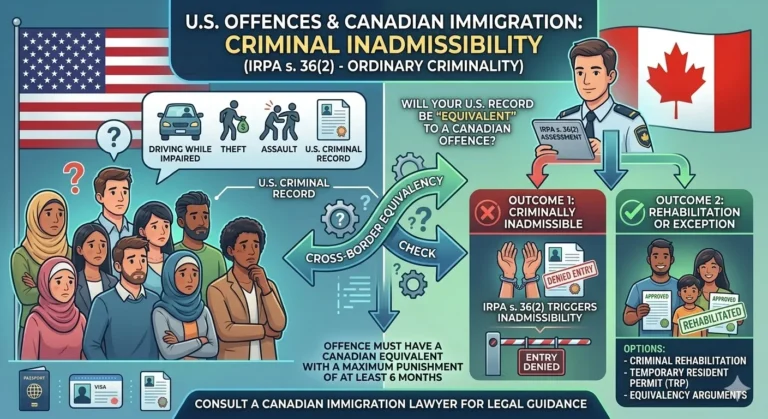
That is because section 36 does not deal only with convictions. It also includes situations
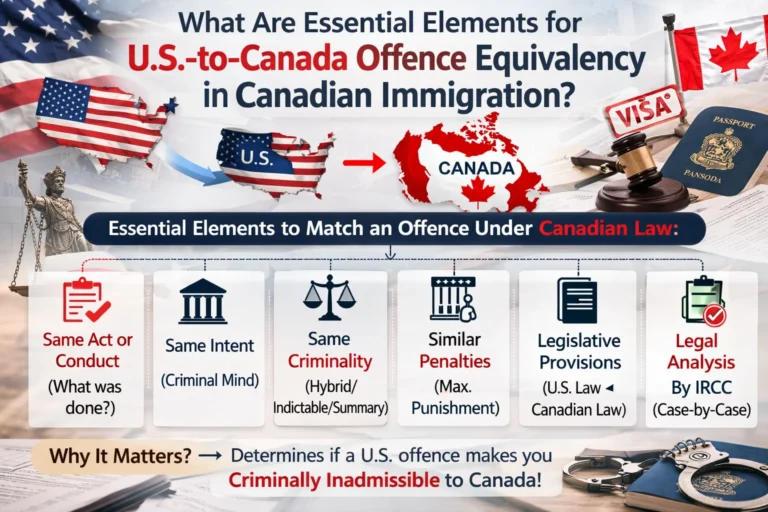
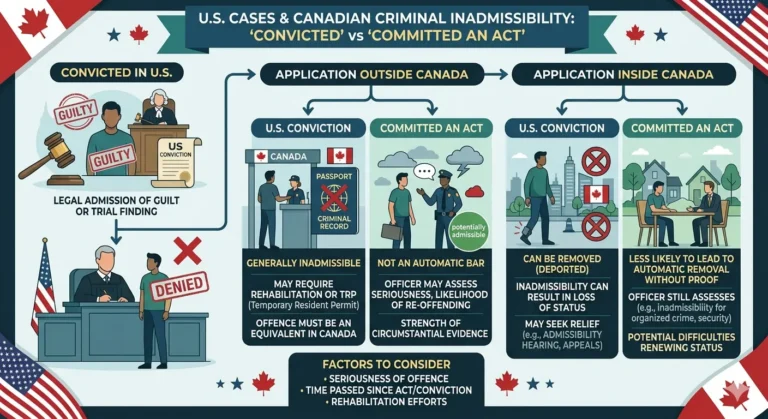
where someone committed an act outside Canada that is an offence where it occurred and would also be an offence in Canada. For serious criminality, that appears in section 36(1)(c). For criminality, it appears in section 36(2)(c).
In practical terms, that means a foreign national can sometimes face inadmissibility even
without a foreign conviction, if immigration authorities have enough reliable information to conclude there are reasonable grounds to believe the act was committed. That is one reason people are sometimes shocked to discover that a withdrawn charge, a dismissed case, or unresolved allegations can still lead to immigration questions at the border.
Why permanent residents usually encounter the issue differently
Permanent residents are often affected in a different way.
Most commonly, the immigration problem starts after a criminal conviction in Canada.
Section 36(1)(a) says a permanent resident or foreign national can be inadmissible for serious criminality if they were convicted in Canada of an offence punishable by a maximum term of imprisonment of at least 10 years, or if a term of imprisonment of more than six months was imposed.
So in that kind of case, the immigration consequences follow a conviction that had to be proved
in criminal court beyond a reasonable doubt first.
That is why permanent residents often experience this issue through the criminal process
first, and the immigration process second.
The important point: these standards do different jobs
This is really the heart of it.
Beyond a reasonable doubt decides whether someone is criminally guilty.
Reasonable grounds to believe helps decide whether immigration authorities can treat certain facts as established for inadmissibility purposes.
They are doing different jobs in different legal systems.
That is why a person can sometimes avoid a criminal conviction and still face immigration
trouble. It is also why someone with a Canadian conviction may suddenly face very serious immigration consequences after the criminal case is over.
Why this matters so much in real life
This difference is not just technical.
It affects real people making real decisions.
A foreign national may think, “The charges were dropped, so this should not matter.” But
immigration may still ask whether there are reasonable grounds to believe the act happened.
A permanent resident may think, “It is only a short sentence.” But if there is a conviction in Canada that falls under section 36, the immigration consequences can be severe. The Supreme Court’s decision in Tran shows how important section 36 can be in practice, especially when sentencing and serious criminality are being assessed.
Final thought
If there is one takeaway, it is this: criminal law and immigration law do not ask the same
question in the same way.
Criminal court asks whether guilt was proved beyond a reasonable doubt.
Immigration law may ask whether there are reasonable grounds to believe the act happened and
whether that is enough to trigger inadmissibility.
That is why people with criminal charges, old allegations, or convictions should not assume the immigration answer will be obvious. Often, it is not.
Sources
● Immigration and Refugee Protection Act
● IRPA, section 33
● IRPA, section 36
● Mugesera v. Canada (Minister of Citizenship and Immigration), 2005 SCC 40
● Tran v. Canada (Public Safety and Emergency Preparedness), 2017 SCC 50
Disclaimer
This article is for general educational purposes only and is not legal advice. Immigration and
criminal consequences depend heavily on the facts of each case. If you are facing a criminal charge, a past allegation, or possible inadmissibility, get legal advice before making decisions that could affect your status in Canada.
Written
by:
Dr. Muhammad
Abrar (Barrister and Solicitor)
Author | Writer | Mentor | Legal Researcher | Canadian
Immigration Case Law and Statistics Analyst