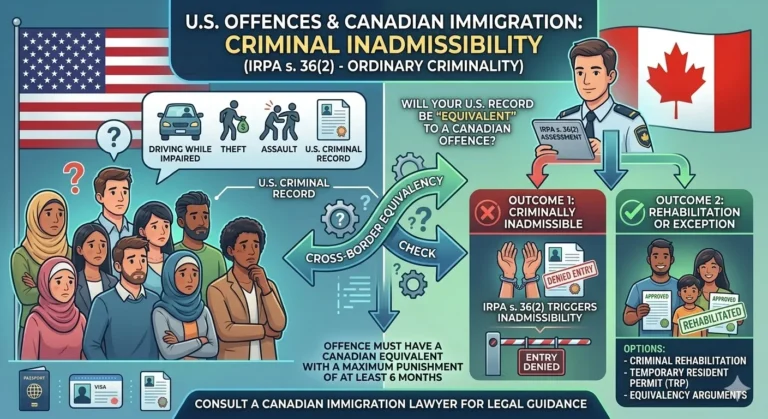
For many Americans, the first surprise is learning that an old conviction can still create problems at the Canadian border. People often assume that if a sentence is finished, the issue is behind them. But Canada looks at criminal history through its own immigration rules, not through the way a U.S. court or state system may describe the case.
That is exactly why rehabilitation applications matter.
The IRCC New York operational report explains that the United States and Canada share the longest border in the world, with over ten million U.S. visitors to Canada annually. At the same time, the report notes that the U.S. has a very high rate of criminal records, estimating that 1 in 15 U.S.
citizens has some kind of criminal record, and that more than one million DUI arrests are recorded in the U.S. every year. That combination creates a significant number of cases involving Americans who want to come to Canada but may be criminally inadmissible. See the operational report you uploaded, especially its opening summary and context discussion in IRCC-NY-Report.pdf.
What a rehabilitation application actually does?
A rehabilitation application is the formal process used to ask Canada to recognize that a person with a past conviction has been rehabilitated and no longer poses an ongoing concern for admissibility purposes.
In practical terms, if the application is approved, the person is no longer inadmissible because of that offence. This is why rehabilitation is often such an important option for Americans who want to travel to Canada for family visits, business, tourism, work, study, or immigration.
The IRCC New York report also makes clear that this is not a fringe issue. IRCC New York handled a very large share of the global rehabilitation caseload, processing about two-thirds of rehabilitation files worldwide in the years discussed in the report. That gives some helpful context: these applications are a normal, well-established part of Canada’s immigration system, not an unusual exception. See IRCC-NY-Report.pdf.
When someone can apply for rehabilitation
In general, a person becomes eligible for rehabilitation only after enough time has passed
since the sentence was fully completed. That does not just mean jail time. It also includes probation, fines, licence suspensions where relevant, and any other part of the sentence that had to be completed.
The U.S. Criminality Assessment Guide and the operational report both reinforce how important it is to look closely at the record before deciding whether someone is eligible. One of the recurring issues identified by IRCC New York was that many applications arrived incomplete or were filed before the case was properly documented. According to the operational report, more than 25%
of received applications were incomplete, often because applicants were missing updated federal records, state police records, court documents, or fees. That is a good reminder that timing and documentation matter just as much as eligibility. See IRCC-NY-Report.pdf.
Deemed rehabilitation vs. individual rehabilitation
Not every person needs the same kind of solution.
In some cases, a person may be considered deemed rehabilitated, meaning enough time has passed and the offence falls into a category where a separate application may no longer be required. In other cases, the person needs to file for individual rehabilitation, which is a formal
application asking for a decision.
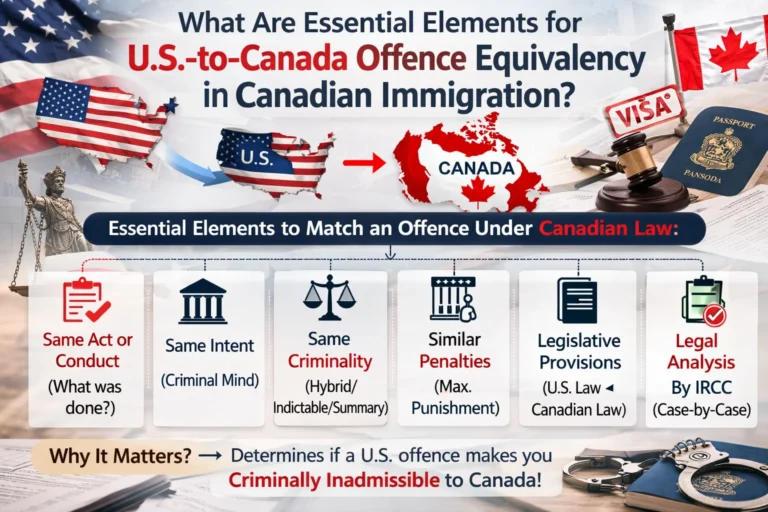
The U.S. Criminality Assessment Guide is helpful here because it shows how technical these determinations can become. It explains, for example, that deemed rehabilitation does not apply to every type of offence and that the legal analysis depends heavily on the Canadian equivalent of the U.S. offence, the sentence, and the time that has passed. It also notes that people found inadmissible for more serious criminality are not eligible for deemed rehabilitation in the same way. See IRCCNYGuide.pdf.
What officers look at when reviewing an application
A rehabilitation application is not just about whether enough time has passed. Officers also look at the person’s overall situation.
The guide and report together show that officers look for a clear and organized record of the offence, proof that the sentence was completed, and signs that the applicant has moved forward in a stable and responsible way. The internal guide refers to factors such as:
● the steps taken toward rehabilitation,
● the likelihood of not offending again,
● acceptance of responsibility,
● evidence of remorse where appropriate,
● counselling or treatment if relevant,
● and stability in employment, family life, education, or community involvement.
That tells us something important: a strong rehabilitation application is not only a paperwork exercise. It is also about telling a clear and credible story about who the person is now. See IRCCNYGuide.pdf.
Why U.S. cases can be more complicated than people expect
One of the most useful parts of the materials you shared is how clearly they explain the
complexity of U.S. criminal records.
The operational report points out that U.S. criminality can be especially difficult to assess because each of the 50 states has its own criminal code and criminal justice system, on top of the federal system. The guide adds even more detail by breaking down differences in state laws, expungements, pardons, sealed records, and court procedures. It also notes that some states do not report fully to the FBI and that certain records may need to be supplemented with state records or court dispositions.
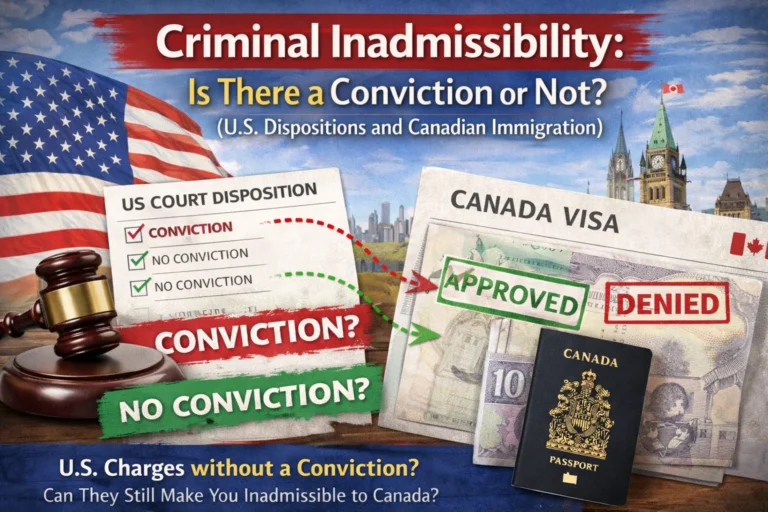
Another important point from the guide is that a U.S. expungement or pardon does not automatically erase inadmissibility for Canada. Whether Canada will recognize the effect of that relief depends on a legal analysis, not simply on the label used by the U.S. state. That is one of the biggest areas where people can make incorrect assumptions. See both IRCCNYGuide.pdf and
IRCC-NY-Report.pdf.
Rehabilitation is not the same as a Temporary Resident Permit
This is another point that often causes confusion.
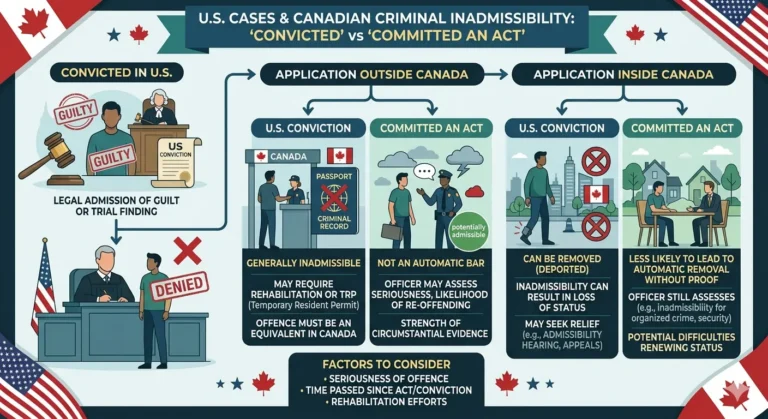
A Temporary Resident Permit (TRP) can sometimes allow a person to enter Canada temporarily even though they are still inadmissible. Rehabilitation is different. Rehabilitation is meant to address the inadmissibility itself on a more permanent basis.
The guide includes separate procedures for TRPs and rehabilitation, which makes the distinction quite clear. In many situations, a person who is not yet eligible for rehabilitation may still explore a TRP if they have a compelling need to travel. But where rehabilitation is available and appropriate, it is often the better long-term solution. See IRCCNYGuide.pdf.
How legal guidance can help
The strongest takeaway from both documents is that these cases are often much more technical
than they first appear.
A rehabilitation application may require a careful review of FBI and state records, court documents, sentencing details, the Canadian equivalent of the offence, and the effect of any expungement, sealing order, or pardon. On top of that, the application needs to be complete and persuasive.
For Americans trying to enter Canada, this is where legal guidance can make a real difference. A careful review up front can help answer the questions that matter most: whether the offence actually creates inadmissibility, whether the person is eligible for rehabilitation, and how the application should be presented.
If you have a U.S. criminal record and want to know whether you may still be able to enter Canada, a legal review can help determine the Canadian equivalency of the offence, whether you may qualify for rehabilitation, and what supporting documents will matter most.
If you are facing admissibility concerns, including criminal inadmissibility, A&M Canadian Immigration Law Corporation in Winnipeg is here to help. Reach out or book a consultation online.
Sources
● IRCC New York U.S. Criminality Assessment Guide
● IRCC New York Operational Report on Rehabilitation Applications (2018–2020)
● Immigration and Refugee Protection Act, section 36
Disclaimer (Educational Use Only)
This content is for general educational information only and is not legal advice. Immigration
laws, regulations, and policies can change. For advice about your specific situation, speak with a qualified immigration lawyer about whether you may be inadmissible and what options may apply.
Written
by:
Dr. Muhammad
Abrar (Barrister and Solicitor)
Author | Writer | Mentor | Legal Researcher | Canadian
Immigration Case Law and Statistics Analyst