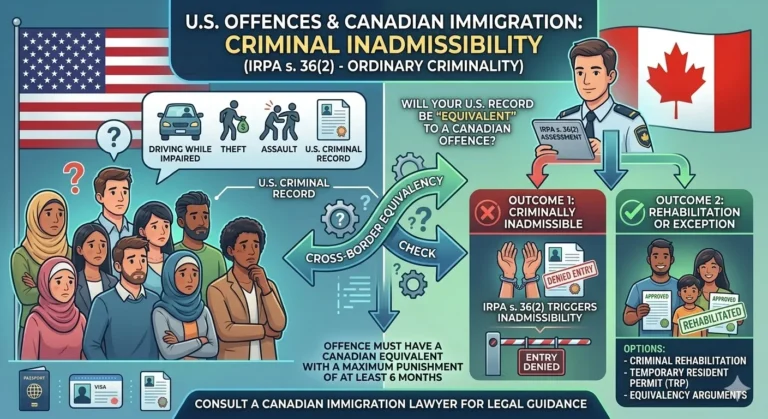
A lot of Americans assume that if there was no conviction, or if the criminal case did not end in the most serious way possible, Canadian immigration authorities cannot rely on it. That is not always correct.
For temporary residents and other foreign nationals entering Canada, immigration law uses
a different evidentiary standard than criminal court. Instead of requiring proof beyond a reasonable doubt, the Immigration and Refugee Protection Act says that inadmissibility findings under sections 34 to 37 may be based on facts for which there are reasonable grounds to believe they occurred, are occurring, or may occur.
That matters because criminal inadmissibility under section 36 IRPA includes both serious criminality and criminality, and both categories can affect foreign nationals trying to enter Canada temporarily.
Why this issue matters for temporary residents
Temporary residents include people entering Canada as visitors, students, or workers.
Americans crossing the border for a short trip are generally being examined as foreign nationals seeking temporary entry.
That status matters because section 36(2), the ordinary criminality provision, applies to foreign nationals only, while section 36(1), the serious criminality provision, applies to both permanent residents and foreign nationals. So a temporary resident can potentially be assessed under either provision depending on the offence and the facts.
The legal standard is not “beyond a reasonable doubt”
In criminal court, the state must prove guilt beyond a reasonable doubt before a conviction can be entered. Immigration law serves a different purpose. It is not deciding whether to punish someone with a criminal sentence. It is deciding whether the person is admissible to Canada.
Section 33 IRPA sets the standard for inadmissibility findings under sections 34 to 37. It says those findings may be based on facts for which there are reasonable grounds to believe they have occurred, are occurring, or may occur.
That does not mean officers can rely on rumor or guesswork. It does mean they do not need the
same level of proof required for a criminal conviction.
A quick comparison of the two standards
Standard | Where it
applies | What it
generally means |
Beyond a
reasonable doubt | Criminal court | Highest
standard; required for conviction |
Reasonable
grounds to believe | Immigration
inadmissibility findings | Credible basis
to believe the facts occurred |
For border cases, that distinction can be very important. An immigration officer may assess admissibility based on credible records and surrounding facts even where there is no criminal conviction.
Serious criminality vs ordinary criminality under section 36
Section 36 does not use one single category. It separates serious criminality from criminality.
Category | IRPA
provision | Applies to | Main
statutory threshold |
Serious
criminality | s. 36(1) | Permanent
residents and foreign nationals | Includes
offences punishable in Canada by a maximum term of at least 10 years,
with other criteria also listed in the section |
Criminality
(ordinary criminality) | s. 36(2) | Foreign
nationals only | Includes
offences that would constitute an indictable offence in Canada, with
other criteria also listed in the section |
This is the chart that should be used when explaining the difference. It better reflects the actual structure of section 36.
What section 36(1) says about serious criminality
Section 36(1) says that a permanent resident or foreign national is inadmissible on grounds of serious criminality for, among other things:
● a conviction in Canada for an offence punishable by a maximum term of imprisonment of at least 10 years, or an offence for which a sentence of more than six months was imposed,
● a conviction outside Canada for an offence that, if committed in Canada, would constitute an offence punishable by a maximum term of at least 10 years, or
● committing an act outside Canada that is an offence where it occurred and that, if committed in Canada, would constitute an offence punishable by a maximum term of at least 10 years.
For temporary residents, this means a foreign offence can still be analyzed as serious criminality if the Canadian equivalent reaches that threshold.
What section 36(2) says about ordinary criminality
Section 36(2) says that a foreign national is inadmissible on grounds of criminality for, among other things:
● a conviction outside Canada for an offence that, if committed in Canada, would constitute an indictable offence,
● two convictions not arising from a single occurrence that would, if committed in Canada, constitute offences under an Act of Parliament, or
● committing an act outside Canada that is an offence where it occurred and that, if committed in Canada, would constitute an indictable offence.
This is why ordinary criminality matters so much for Americans entering Canada temporarily.
A person does not need to fall into the serious criminality category to be refused entry.
How “reasonable grounds to believe” connects to section 36
The connection between section 33 and section 36 is where many people get confused.
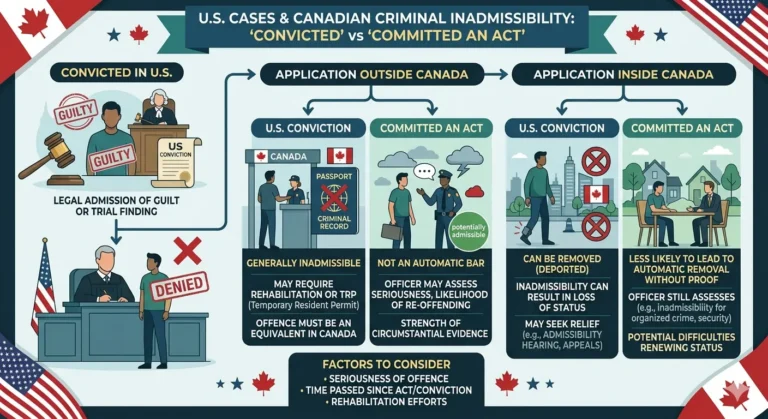
Section 36 includes not only convictions, but also acts committed outside Canada. Because section 33 says inadmissibility findings under sections 34 to 37 can rest on facts for which there are reasonable grounds to believe they occurred, immigration authorities are not always limited to asking whether there was a conviction.
That means an officer may examine whether there is a credible basis to believe the conduct
occurred and whether that conduct would amount to serious criminality or ordinary criminality under Canadian law.
Why this matters when charges were dropped or there was no conviction
This is where the issue becomes very practical.
People often assume that if charges were dismissed, withdrawn, or never resulted in a conviction, the matter ends there. In criminal court, the absence of a conviction is obviously significant. In immigration law, however, the analysis may still turn to the underlying conduct if section 36 is engaged through the “committing an act outside Canada” language and the officer has reasonable
grounds to believe the facts occurred.
That does not mean every dropped charge leads to inadmissibility. It means the legal
framework is broader than many travelers expect.
Common examples for temporary residents
The exact analysis always depends on the statute, the facts, and the Canadian equivalent,
but this chart shows how the comparison is usually approached.
U.S. issue | Likely
Canadian equivalent | Possible
section 36 concern |
DUI / DWI | Impaired
driving | Often analyzed
as serious criminality |
Simple assault | Assault | Often ordinary
criminality, sometimes more depending on the facts |
Theft /
shoplifting | Theft | Often ordinary
criminality |
Drug
possession | CDSA offence | May be ordinary
criminality or serious criminality depending on the offence |
IRCC specifically notes that impaired driving may lead to inadmissibility for serious criminality.
Why Canadian equivalency is still the real legal question
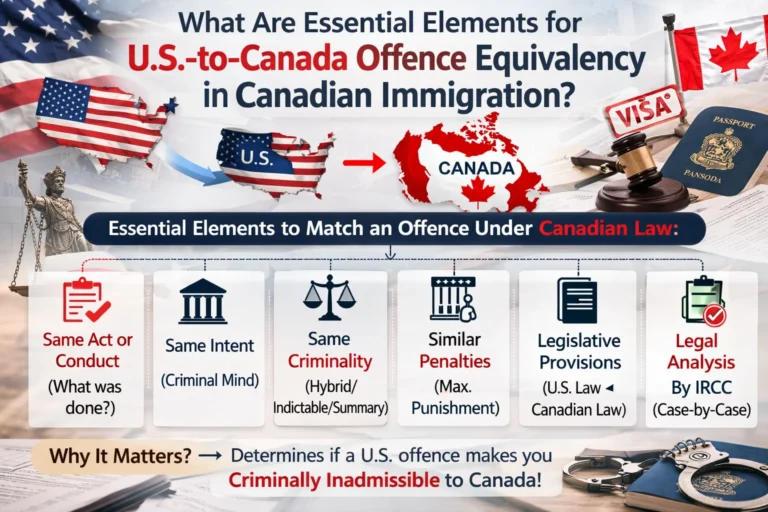
Even when reasonable grounds are involved, the officer still has to connect the facts to Canadian law.
The core questions are usually:
● What conduct is supported by the records?
● Is there reasonable ground to believe it occurred?
● What is the closest Canadian equivalent?
● Does that equivalent fall under serious criminality or criminality?
That is why border issues are rarely solved by looking only at the U.S. label like “misdemeanor” or “felony.” Section 36 works through Canadian legal equivalents, not American shorthand.
Why this matters before travel
For temporary residents, this issue can surface at exactly the wrong time: when the trip is already booked and the person is standing at the border. IRCC’s guidance confirms that temporary residents can be criminally inadmissible if they were convicted outside Canada of something considered a crime in Canada, or if they committed an act outside Canada that is considered a crime where it occurred and would be punishable under Canadian law.
If there is a risk that section 36 may apply, it is usually better to assess the issue before travel rather than hoping it will not come up.
What options may still exist
A finding of inadmissibility does not always mean the end of travel plans. IRCC states that a person who is criminally inadmissible may have options such as a Temporary Resident Permit or, where the timing and facts allow, criminal rehabilitation. IRCC also notes that at least five years must usually have passed since the end of the sentence, including probation, before criminal rehabilitation can be considered.
The right option depends on whether the case involves serious criminality or ordinary criminality, when the sentence was completed, and how the records line up with Canadian law.
Educational purpose of this article
This article is intended for general educational purposes only. It is meant to help readers understand how the reasonable grounds to believe standard can interact with serious criminality and criminality under section 36 IRPA for temporary residents and other foreign nationals.
A&M Canadian Immigration Law Corporation helps Americans and U.S. residents assess
whether a past offence, charge history, or underlying conduct may create criminal inadmissibility issues in Canada. That may include reviewing records, identifying the likely Canadian equivalent, and assessing whether the case may raise serious criminality or ordinary criminality under section
36.
Disclaimer
This article is for general educational purposes only and is not legal advice. Immigration law
can change, and every case depends on its own facts. Legal advice should be obtained before making travel plans or filing any application.
Sources
● Immigration and Refugee Protection Act, section 33
● Immigration and Refugee Protection Act, section 36
● Find out if you’re inadmissible
● Overcome criminal convictions
● Guide 5312 – Rehabilitation for persons inadmissible to Canada because of past criminal activity
Written by:
Dr. Muhammad
Abrar (Barrister and Solicitor)
Author | Writer | Mentor | Legal Researcher | Canadian
Immigration Case Law and Statistics Analyst