A lot of people
think criminal inadmissibility only comes up when there is a straightforward
conviction for something like DUI, assault, or theft.
But Canadian
immigration law can become much more complicated when the issue involves foreign
conduct, family records, or allegations that someone submitted false
official documents outside Canada.
That is what
makes Farenas v Canada (Citizenship and Immigration), 2011 FC 660 such
an important case.
This decision
shows that when immigration authorities say something done outside Canada would
amount to a Canadian crime, they cannot just make that leap without doing the
legal work. They still have to explain why the foreign conduct actually matches
the Canadian offence they are relying on.
For Americans
and U.S. residents, that matters because past family law issues, document
irregularities, or conduct outside Canada can still raise immigration concerns
when applying to enter or remain in Canada.
What
happened in Farenas?
Linda Escanilla
Farenas applied for permanent residence in Canada under the live-in
caregiver class. She included her husband and son in the application.
The immigration
concerns came from events in the Philippines involving:
● a later birth registration for her son that listed a
different father than an earlier birth registration,
● a second marriage while immigration authorities
believed the first marriage might still have existed,
● and allegations that false information had been
submitted in official records.
The officer
believed this conduct could amount in Canada to offences such as:
● causing false information to be inserted into a birth
register,
● bigamy,
● and perjury.
The officer
also believed there may have been misrepresentation under the Immigration
and Refugee Protection Act.
On that basis,
the application was refused.
What was Ms.
Farenas’ explanation?
Ms. Farenas did
not deny that the facts looked unusual. But she gave an explanation that, in
her view, mattered a great deal.
She said that
while working in Saudi Arabia, she met a man who identified himself as Roger
Buenaventura. She became pregnant, returned to the Philippines, and married
him. Soon after the marriage, he disappeared.
She later came
to believe that the man had used a false identity, and that “Roger
Buenaventura” as he had represented himself did not really exist.
Later, she met
her current husband, Redante Garcia. She believed her first marriage was
invalid because the man had lied about who he was. She then married Mr. Garcia
without first having the earlier marriage formally declared void. She also
arranged a later birth registration listing Mr. Garcia as her son’s father,
since he was raising the child as his own.
Her position
was basically this: she never intended to commit fraud or a criminal offence.
That became
very important in the Court’s analysis.
Why this
matters for Americans and U.S. residents
For Americans
and U.S. residents, Farenas is a reminder that Canadian immigration law
can look beyond the usual criminal offences.
Not every
inadmissibility concern comes from an obvious conviction. Sometimes immigration
authorities may look at:
● foreign marriage records,
● birth registrations,
● sworn statements,
● or other official documents created outside Canada.
If they believe
those acts would amount to a criminal offence in Canada, they may try to treat
the matter as criminal inadmissibility.
That means
people with complicated family histories, foreign civil documents, or past
record discrepancies should not assume the issue is only about “real crimes” in
the ordinary sense.
What did the
Court say the officer got wrong?
The Federal
Court found that the officer’s analysis was not good enough.
The officer
did not do a proper equivalency analysis
This was the
biggest issue in the case.
If an officer
says that something done outside Canada would amount to a Canadian criminal
offence, the officer has to explain how.
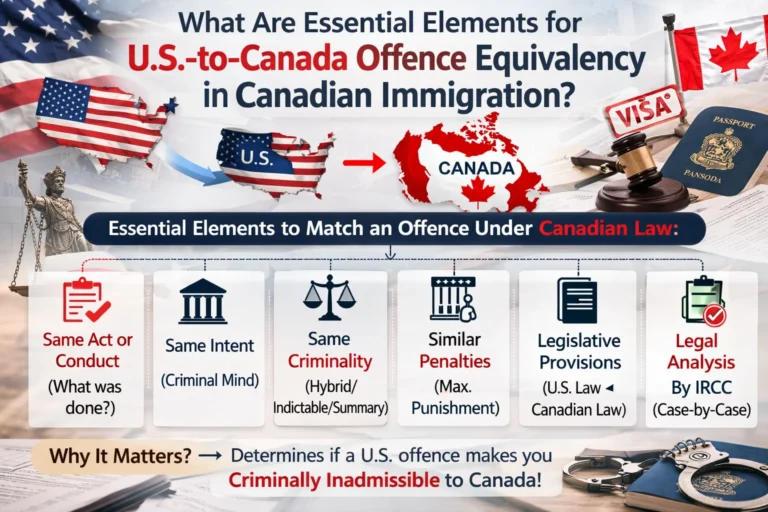
That means
identifying the essential legal elements of the Canadian offence and showing
why the facts actually match those elements.
In Farenas,
the Court found that this had not been done properly.
The officer
pointed to bigamy, perjury, and false birth registration offences, but did not
provide the kind of careful legal analysis needed to justify the finding of
inadmissibility.
That was
especially important because this was not a simple case where the foreign
conduct clearly lined up with a Canadian offence on its face.
Intent
mattered, and the officer did not deal with it properly
This was
particularly important for the alleged bigamy finding.
The Court noted
that both Canadian and Filipino law require mens rea, meaning the right
state of mind, for a finding of bigamy.
Ms. Farenas’
whole explanation was that she believed the first marriage was invalid because
the man had used a false identity. In other words, she said she did not believe
she was legally married when she entered into the second marriage.
The Court found
that the officer did not properly deal with that issue at all.
Instead, the
officer treated bigamy almost like a strict-liability offence, which it is not.
For Americans
and U.S. residents, this part of the case matters because it shows that
immigration officers cannot ignore state of mind, honest belief,
or possible mistake of fact when deciding whether foreign conduct would
amount to a crime in Canada.
Troubling
facts are not enough by themselves
The Court did
not say the facts were harmless. In fact, Justice Near specifically said the
alleged misrepresentations about the marriage and the child’s father were
troubling.
But troubling
facts alone were not enough.
The Court made
it clear that even if the situation raises concerns, the officer still has to
do the legal analysis properly. Suspicion does not replace reasoning.
What about
humanitarian and compassionate grounds?
This is another
part of Farenas that gets cited often.
Ms. Farenas
argued that the officer should have considered humanitarian and
compassionate grounds, even though she had not expressly made an H&C
application.
The Court
rejected that argument.
It said that
while an officer may sometimes raise H&C relief on their own initiative,
they are not required to do so. If an applicant wants H&C
consideration, they generally need to ask for it clearly and provide the
necessary information.
That point
still matters today.
For Americans
and U.S. residents dealing with inadmissibility issues, it is a reminder not to
assume an officer will automatically treat a personal explanation as a request
for discretionary relief.
What did the
Court decide?
The Federal
Court allowed the application for judicial review.
The decision
was sent back for redetermination because the officer had not provided adequate
reasons and had failed to do a sufficient equivalency analysis.
The Court did not decide that Ms. Farenas was automatically admissible. It decided that the
reasoning used to find her inadmissible could not stand.
What this
case means in practice
For Americans
and U.S. residents, Farenas is a useful reminder of a few things.
First, criminal
inadmissibility can involve more than just obvious criminal convictions.
Second, if
immigration authorities say foreign conduct would amount to a Canadian crime,
they have to actually prove that through proper reasoning.
Third, where
the Canadian offence depends on intent, knowledge, or honest
belief, the officer has to deal with those issues directly.
And finally, if
someone wants humanitarian and compassionate relief, it should usually be
raised clearly rather than left for the officer to infer.
At A&M
Canadian Immigration Law Corporation, we help clients deal with criminal
inadmissibility and misrepresentation concerns involving:
● foreign conduct,
● foreign civil or official documents,
● family-record discrepancies,
● equivalency analysis under Canadian law,
● and decisions where officers may have relied on
incomplete legal reasoning.
Cases like Farenas show how important it is to look carefully at the officer’s analysis, not just
the allegation itself.
If you are an
American or U.S. resident dealing with criminal inadmissibility concerns
tied to foreign conduct or foreign records, it may be worth reviewing the
case carefully before moving forward with an application.
A careful legal
review can help determine whether the foreign conduct actually supports a
finding of inadmissibility under Canadian law.
Sources
Farenas
v Canada (Citizenship and Immigration), 2011 FC 660
Immigration
and Refugee Protection Act
Immigration
and Refugee Protection Act, section 36
Immigration
and Refugee Protection Act, section 40