When Canadian
immigration officers assess criminal allegations from another country, they
cannot just focus on the original accusation and ignore everything that came
after it. They have to look at the full record, consider any available defence
under Canadian law, and explain why the evidence supports inadmissibility.
That is the
lesson from Garcia v Canada (Citizenship and Immigration), 2021 FC 141.
This case is
important because it shows that a finding of criminal inadmissibility cannot
rest on assumptions, incomplete reasoning, or a failure to deal with evidence
that points the other way.
What
happened in Garcia?
Lorebeth Garcia
applied for permanent residence in Canada as a member of the live-in caregiver
class. Her husband, Joresce Ballesteros, was included as a family member on the
application.
The problem
arose because of a 2006 fight in the Philippines outside a karaoke bar. Mr.
Ballesteros and four others were charged with frustrated homicide after
another man, Joenard Humiwat, suffered serious injuries.
But the
evidence did not all point in one direction.
Mr. Ballesteros
and the other accused said they had acted in self-defence. Their account
was that there had been tension inside the bar, and after they left, one of the
other men stabbed one of their companions without warning. Mr. Ballesteros said
he was stabbed as well when he tried to intervene.
Then, in 2009,
the complainant signed an Affidavit of Desistance. In that affidavit, he
said the accused had no intention to kill or injure him and that if
called to testify, he would give evidence that would completely exonerate them. After that, the charges were dismissed.
Even so, a visa
officer later concluded that there were reasonable grounds to believe that Mr. Ballesteros had committed an act outside Canada that would amount in
Canada to assault causing bodily harm under sections 265 and 267 of the
Criminal Code. On that basis, he was found inadmissible under section
36(1)(c) of the Immigration and Refugee Protection Act. Because he
was found inadmissible, Ms. Garcia’s own permanent residence application was
refused as well.
What did the
officer rely on?
The officer
relied mainly on the original version of events and the complainant’s medical
records showing significant injuries.
Later, in the
GCMS notes, the officer also suggested that in the Philippines it was “common
practice” to settle cases outside court and then use affidavits of desistance
to get charges dismissed. On that basis, the officer discounted the affidavit
and maintained the inadmissibility finding.
That became a
major issue before the Federal Court.
What did the
Federal Court decide?
Justice
McHaffie found that the officer’s decision was both unreasonable and procedurally
unfair.
The Court
allowed the judicial review and sent the matter back for redetermination by
a different officer.
The Court did
not say Mr. Ballesteros was automatically admissible. What it said was that the
officer’s reasoning could not stand.
What this
case teaches us
1. Officers
must deal with self-defence, not just the allegation
One of the
clearest lessons from Garcia is that if an officer is deciding whether
conduct outside Canada would amount to a Canadian offence, the officer has to
consider not only the elements of the offence, but also any relevant defences under Canadian law.
That mattered
here because Mr. Ballesteros had consistently said he was acting in
self-defence. The Court pointed to section 34 of the Criminal Code and made
clear that the officer could not simply ignore that issue.
In other words,
if self-defence is central to the person’s explanation, it has to be addressed
in a meaningful way.
2. Withdrawn
charges still matter — but they cannot be brushed aside
The case also
shows that a withdrawn charge is not automatically the end of the story, but it
is certainly not irrelevant either.
The complainant
in Garcia later swore that the accused had no intention to injure him
and that his evidence would exonerate them. The officer was not required to
accept that at face value without question. But if the officer was going to
reject it, the officer had to explain why.
That
explanation was missing.
So one of the
big takeaways from Garcia is this: if an officer wants to find
inadmissibility despite withdrawn charges and exculpatory evidence, the
reasoning has to be careful, detailed, and grounded in the record.
3. Officers
cannot speculate about settlements
Another
important lesson from Garcia is that immigration officers cannot fill
gaps in the evidence with speculation.
The officer
assumed the Affidavit of Desistance was probably part of a settlement because,
in the officer’s view, that was common practice in the Philippines. But there
was no evidence in the file showing that any settlement had actually happened.
The Court said
that was unreasonable.
This matters
because inadmissibility findings can have major consequences. If an officer is
going to reject sworn evidence and rely on some alternative explanation, that
explanation needs to come from evidence — not guesswork.
4.
Procedural fairness still matters in inadmissibility cases
The Court also
made an important fairness point.
Even though
visa officers are often owed a lower level of procedural fairness than courts,
that does not mean they can rely on crucial outside assumptions without giving
the applicant a chance to respond.
Here, the
officer relied on assumptions about how affidavits of desistance are supposedly
used in the Philippine justice system, but that issue was never put to Ms.
Garcia before the decision was made.
That was
unfair.
So another
lesson from Garcia is that if an officer is going to rely on a point
that is central to the decision, especially one that contradicts the
applicant’s evidence, the applicant should have a chance to answer it.
5.
“Reasonable grounds to believe” still requires real analysis
The standard
under section 33 of IRPA is lower than proof beyond a reasonable doubt. But Garcia reminds us that reasonable grounds to believe is still a real legal
standard.
It requires
compelling and credible information. It also requires the decision-maker to
explain why the evidence supports the conclusion.
The officer in Garcia did not do that. The Court said the decision lacked the justification,
transparency, and intelligibility required under Vavilov.
So the lesson
here is simple: a lower standard does not mean a lower duty to reason properly.
Why this
case matters for immigration applicants
Garcia matters because it shows how foreign
allegations can create immigration problems even without a conviction, but it
also shows that officers do not have unlimited freedom in how they assess those
allegations.
If there is
evidence of:
● withdrawn charges,
● conflicting witness accounts,
● self-defence,
● or later sworn statements withdrawing the allegation,
that evidence
has to be dealt with honestly and carefully.
This is
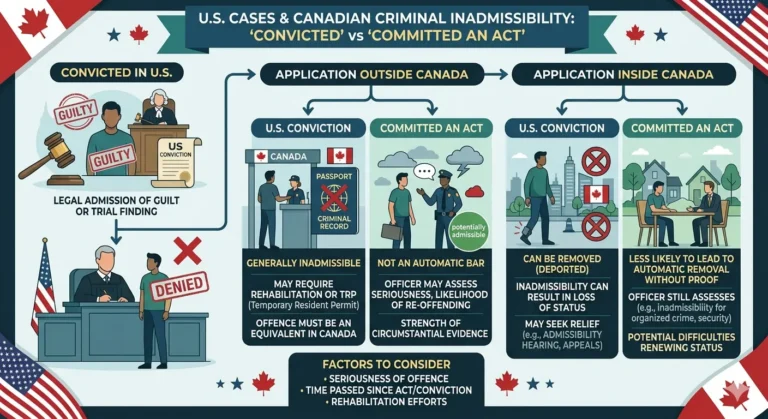
especially important in section 36(1)(c) cases, where the issue is not a
conviction but whether a person committed an act outside Canada that
would be a serious offence in Canada.
At A&M
Canadian Immigration Law Corporation, we help clients deal with criminal
inadmissibility issues involving foreign charges, withdrawn proceedings,
allegations without convictions, and conduct-based findings under section 36.
Cases like Garcia show how important it is to carefully review:
● the foreign court record,
● whether charges were withdrawn or dismissed,
● whether there is evidence supporting a defence such
as self-defence,
● whether the officer actually considered the full
evidentiary record,
● and whether procedural fairness was respected.
These cases are
often much more nuanced than they first appear. A careful legal review can make
a real difference.
Source
Garcia
v Canada (Citizenship and Immigration), 2021 FC 141