Many Americans and other foreign nationals only discover that a past criminal offence may
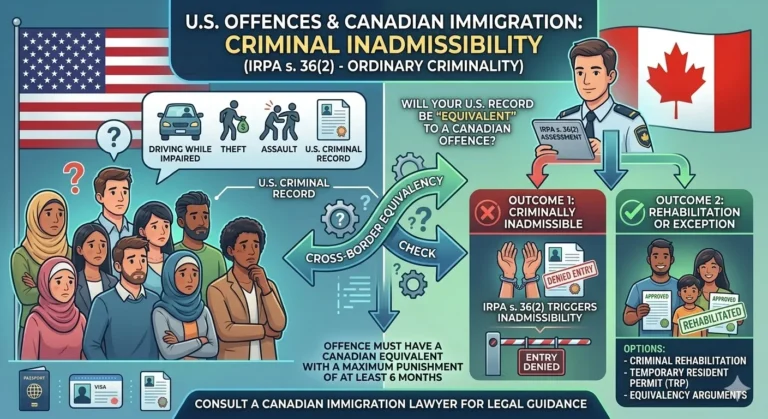
affect entry to Canada when they are already planning a trip or standing at the border. Something that seemed resolved years earlier—such as a DUI, theft charge, or assault conviction—can suddenly become relevant under Canadian immigration law.
Canadian authorities may refuse entry to someone who is criminally inadmissible under section 36 of the Immigration and Refugee Protection Act (IRPA). However, Canadian law also allows a limited exception in certain circumstances.
A Temporary Resident Permit (TRP) may allow a person who is otherwise inadmissible to
enter Canada temporarily if an immigration officer decides that it is justified in the circumstances.
It is important to understand one key point from the beginning: a TRP can possibly allow someone with a criminal record to enter Canada, but approval is never guaranteed.
What a Temporary Resident Permit is
A Temporary Resident Permit is an authorization issued under section 24 of the Immigration and Refugee Protection Act. It allows a foreign national who is otherwise inadmissible—or who does not meet all requirements of the Act—to enter or remain in Canada temporarily if an officer determines that it is justified in the circumstances.
Key points about TRPs include:
● They are discretionary decisions made by immigration officers
● They grant temporary resident status for a limited period
● They do not permanently remove inadmissibility
● They can be cancelled at any time
Because of this discretionary nature, a TRP should not be viewed as a guaranteed way to enter
Canada. It is a temporary exception that may be granted in certain circumstances.
Who typically needs a TRP
Temporary Resident Permits most commonly arise when someone is criminally inadmissible
but still needs to travel to Canada for a legitimate reason.
Examples may include:
● business meetings or work assignments
● conferences or professional events
● family emergencies
● important family events such as weddings or funerals
● tourism where travel plans cannot easily be postponed
Many TRP cases involve individuals who cannot yet apply for criminal rehabilitation because enough time has not passed since the completion of their sentence.
Criminal inadmissibility under section 36 IRPA
The legal foundation for most TRP cases involving criminal records is section 36 of the Immigration and Refugee Protection Act.
This section divides criminal inadmissibility into two categories: serious criminality and ordinary criminality.
Serious criminality vs ordinary criminality under section 36
Category | IRPA
provision | Applies to | Main
statutory threshold | Practical
meaning |
Serious
criminality | s.36(1) | Permanent
residents and foreign nationals | Includes
offences punishable in Canada by a maximum term of at least 10 years,
along with other criteria listed in the section | Higher
category of criminal inadmissibility |
Ordinary
criminality | s.36(2) | Foreign
nationals only | Includes
offences that would constitute an indictable offence in Canada, along
with other criteria listed in the section | Still
sufficient to make a temporary resident or visitor inadmissible |
Americans entering Canada temporarily are considered foreign nationals, which means they may be assessed under either category depending on the offence.
Quick comparison: serious criminality vs ordinary criminality
Issue | Serious
criminality | Ordinary
criminality |
IRPA section | s.36(1) | s.36(2) |
Who it applies
to | Permanent
residents and foreign nationals | Foreign
nationals only |
General
threshold | Canadian
offence punishable by a maximum of at least 10 years, plus other
statutory criteria | Offence that
would be indictable in Canada, plus other statutory criteria |
Border impact | May lead to
inadmissibility | May also lead
to inadmissibility |
TRP relevance | A TRP may
still be requested, but approval is discretionary | A TRP may also
be requested where entry is justified |
Even cases that fall within ordinary criminality can still prevent entry to Canada without a permit.
Common offences that lead to TRP applications
Many TRP requests arise from offences that occurred in the United States years earlier.
U.S.
offence | Canadian
equivalent | Possible
inadmissibility issue |
DUI / DWI | Impaired
driving | Often analyzed
as serious criminality |
Simple assault | Assault | Often ordinary
criminality |
Theft /
shoplifting | Theft | Often ordinary
criminality |
Drug
possession | Controlled
Drugs and Substances Act offence | May involve
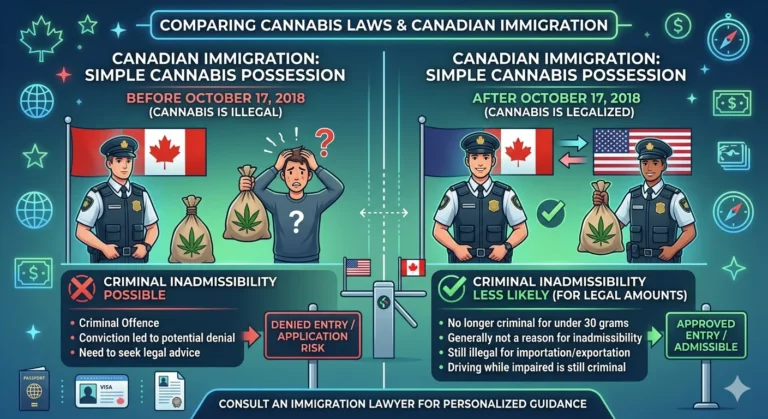
ordinary or serious criminality depending on circumstances |
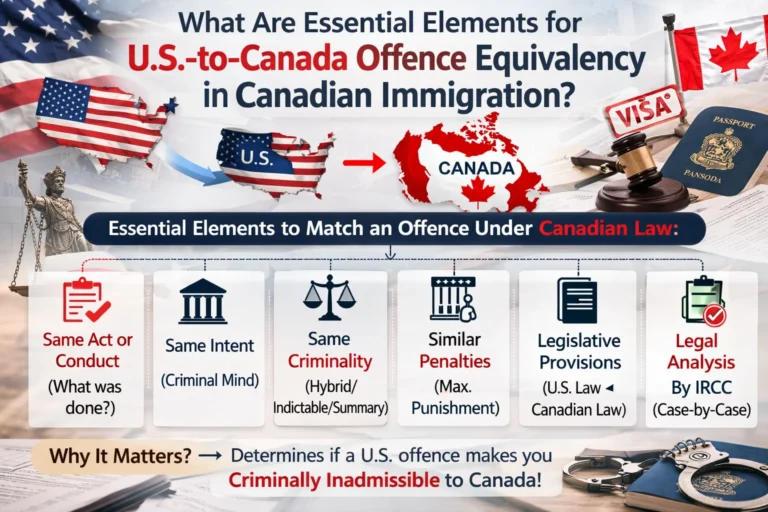
The exact outcome depends on the Canadian equivalent offence, which immigration authorities determine by comparing the foreign law and conduct to Canadian law.
A TRP may allow entry, but approval is not guaranteed
A TRP does not create a right to enter Canada. Immigration officers have broad discretion when
deciding whether to issue one.
In practice, the officer must determine whether the reason for the visit outweighs the potential risk to Canadian society.
This means that even when someone appears eligible for a TRP, the application may still be
refused.
Factors immigration officers may consider
When deciding whether to issue a Temporary Resident Permit, officers may consider a variety
of factors, including:
● the seriousness of the criminal offence
● how long ago the offence occurred
● whether the person has committed additional offences
● the purpose of the trip to Canada
● the likelihood that the person will comply with Canadian laws
The decision ultimately depends on whether the officer believes issuing the permit is justified.
How long a TRP can last
Temporary Resident Permits may be issued for different lengths of time depending on the
circumstances.
Examples may include:
● a few days for a short visit
● several months for repeated travel
● longer periods if the circumstances justify it
However, the permit only remains valid for the time specified by the immigration officer.
TRP vs criminal rehabilitation
A TRP is often used when someone needs to travel before becoming eligible for criminal
rehabilitation.
Option | Purpose | Result |
Temporary
Resident Permit | Temporary
solution | Allows entry
for a limited time |
Criminal
Rehabilitation | Permanent
solution | Removes
inadmissibility for the offence |
Many individuals pursue criminal rehabilitation later to resolve the issue permanently.
Why planning ahead matters
Many travelers only learn about criminal inadmissibility when they arrive at the border.
Attempting to address the issue at that moment can lead to refused entry and disrupted travel plans.
Reviewing the situation before traveling can help determine:
● whether criminal inadmissibility may apply
● whether a TRP may be worth considering
● what documentation may be needed
Planning ahead often reduces the risk of unexpected problems at the border.
Educational purpose of this article
This article is provided for general educational purposes only. It is intended to explain how
Temporary Resident Permits may apply to individuals with criminal records under Canadian immigration law.
Every case depends on its specific facts, including the nature of the offence, the Canadian equivalent offence, and the timing of the sentence.
A&M Canadian Immigration Law Corporation assists Americans and other foreign nationals who may face criminal inadmissibility when attempting to enter Canada.The firm can review criminal history, identify the Canadian equivalent of an offence, assess whether the case involves serious criminality or ordinary criminality, and help determine whether a Temporary Resident Permit may be appropriate.
Disclaimer
This article is for general educational purposes only and does not constitute legal advice.
Immigration law can change, and every case depends on its own facts. A Temporary Resident Permit is discretionary and may be refused even where there is a legitimate reason for travel.
Sources
Immigration and Refugee Protection Act – Section 24
Immigration and Refugee Protection Act – Section 36
Temporary Resident Permits – Government of Canada
Criminal inadmissibility – Government of Canada
Written by:
Dr. Muhammad
Abrar (Barrister and Solicitor)
Author | Writer | Mentor | Legal Researcher | Canadian
Immigration Case Law and Statistics Analyst